
In this article5
The Centers for Medicare and Medicaid Services announced this month that its fraud-detection efforts have blocked or recovered more than $1.6 billion in improper Medicare laboratory payments — money billed by labs for tests that, in many documented cases, were never actually performed. Some of the labs involved, according to CMS, weren't operational at all. This is a different kind of fraud story than the ones that usually make it into a Medicare inbox: no phone call, no suspicious text, no mailed package to spot. Your Medicare number can be billed for a phantom lab test entirely behind the scenes. Here's how the scheme works, what CMS actually did about it, and the one habit that catches it.
📋Quick Summary
- CMS says it has stopped or recovered more than $1.6 billion in fraudulent Medicare laboratory payments since the start of the current administration.
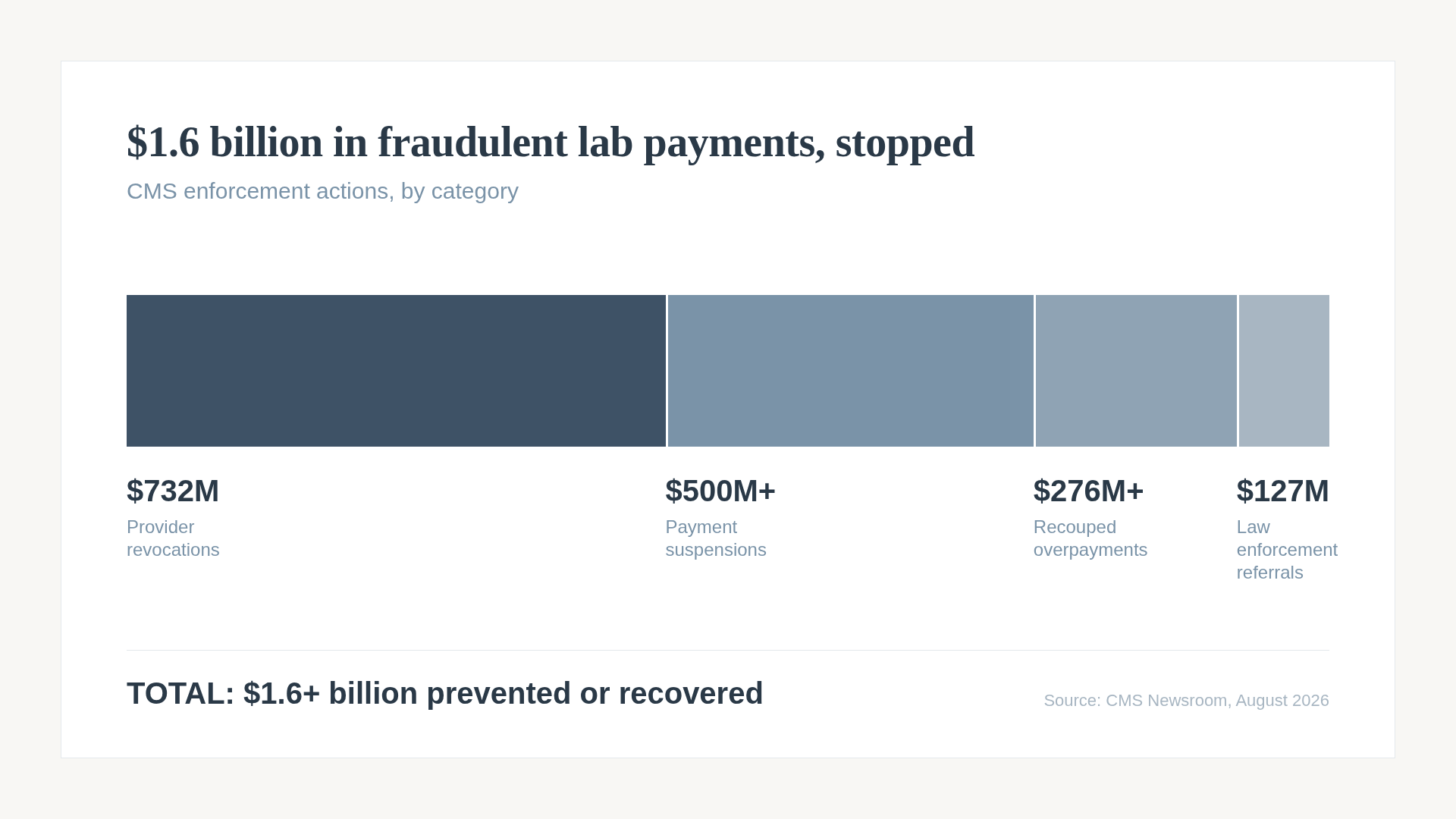
- $732 million of that came from revoking 157 fraudulent lab providers from the Medicare program entirely.
- Over $500 million in payments were halted through 185 payment suspensions tied to an investigation of roughly 600 labs.
- In one cited case, a single individual enrolled 14 non-operational labs in Medicare and billed more than $24 million for tests that couldn't have been performed.
- CMS credits artificial intelligence and machine-learning analysis of billing patterns for identifying much of this activity.
- This type of fraud can appear on your Medicare record without any direct contact ever reaching you.
- Your Medicare Summary Notice is the one document that would show it — reviewing it is free and takes a few minutes.
- This adds to a broader 2026 enforcement push: $1.8 billion in identified overpayments, $378 million collected, and over $539 million in suspended payments so far this year.
How a Lab That Doesn't Exist Bills Medicare
The mechanics behind this fraud pattern are worth understanding, because they explain why it's so hard for an individual beneficiary to catch without specifically looking.
To bill Medicare, a laboratory has to enroll as a Medicare provider — a process that, historically, has been easier to complete than it should be for someone determined to exploit it. Once enrolled, a lab can submit claims for tests performed on Medicare beneficiaries, and Medicare pays according to its fee schedule. The fraud pattern CMS describes involves labs that submit claims for tests that were never actually run — sometimes because the "lab" has no real operations at all, sometimes because tests are billed as more extensive or more numerous than what was actually performed.
CMS Administrator Dr. Mehmet Oz described the core problem plainly: when laboratories bill Medicare for tests they never performed, it drains the Medicare Trust Fund and diverts resources from beneficiaries who need them. The agency has built what it calls a technology-powered fraud prevention operation, using artificial intelligence and machine-learning models to comb through Medicare fee-for-service claims looking for unusual billing patterns — a lab billing an implausibly high volume of tests, a lab whose billing doesn't match any real patient encounters, a lab with no verifiable physical operations.
One case CMS cited illustrates the pattern clearly. An individual running a consulting company enrolled 14 separate laboratories in Medicare's fee-for-service program and billed more than $24 million — despite investigators determining that none of the 14 labs were actually operational. CMS suspensions are currently holding $12 million tied to these entities, another $7 million has already been recovered, and 11 of the 14 labs have had their Medicare enrollments revoked, with investigations continuing on the remaining three.
Related: Could Your Medicare Chart Have a Diagnosis That Isn't Real?
Sources: CMS Newsroom — CMS Prevents $1.6 Billion in Fraudulent Medicare Laboratory Payments; Fierce Healthcare — coverage of the $1.6 billion lab payment enforcement action.
Because this fraud pattern doesn't require any contact with you, the only way to know whether your Medicare number has ever been billed for a phantom lab test is to check the record directly. Your Medicare Summary Notice — mailed every three months, and viewable anytime through your Medicare.gov account — lists every service billed under your Medicare number, including laboratory tests.
Review it for any lab test you don't recognize: a test you don't remember having, from a lab or provider you've never heard of, on a date you can't account for. If you find one, call 1-800-MEDICARE (1-800-633-4227) to report it. This is a genuinely quick check, and given that CMS itself just confirmed hundreds of millions of dollars in this specific fraud type were caught only through analytics rather than beneficiary reports, your own review adds a second layer of protection the algorithms can't fully replace.
Why This Matters Even Though It Doesn't Cost You Directly
Unlike most fraud stories, phantom lab billing doesn't typically produce an out-of-pocket bill for the beneficiary — Medicare pays the claim directly to the lab, and in most cases the patient never sees a charge. That can make this feel like a victimless problem from the individual's perspective. It isn't, for a few concrete reasons.
First, fraudulent billing under your Medicare number creates a false entry in your claims history, similar in spirit to the concerns we've covered around inaccurate diagnosis codes. A phantom lab test showing up on your record — even one that cost you nothing directly — can complicate how future claims or reviews interpret your medical history, and it's worth having corrected regardless of whether money changed hands on your end.
Second, and more broadly, every dollar of fraudulent lab billing draws directly from the Medicare Trust Fund that all beneficiaries ultimately depend on. Money paid to a lab that performed no test is money not available for legitimate care, and at scale — $1.6 billion in this single enforcement effort alone — this kind of fraud is a real contributor to the financial pressures behind future premium and trust-fund projections that affect every Medicare beneficiary, not just those whose numbers were directly misused.
Third, this case is a useful data point in a broader pattern of enforcement activity across multiple categories. CMS's own figures show that since January 1, 2026, its Fraud Defense Operations Center has flagged more than $371 million in suspended payments across 267 providers and suppliers — including over $226 million tied to durable medical equipment, more than $53 million involving skin substitute products, and more than $23 million involving hospice providers. Laboratory billing is one front in a wider effort, not an isolated one.
Related: Did You Get Medical Equipment You Never Ordered? It's a Scam and Could You Be Enrolled in Hospice Care Without Knowing It?
Sources: MyChesCo — CMS says lab fraud crackdown blocked $1.6 billion in payments; Townhall — CMS stops $1.6 billion in fraudulent Medicare lab payments.
Related Medicare Updates
✅What This Means For You
If you've had any lab work done recently: Pull up your most recent Medicare Summary Notice and confirm every lab test listed matches something you actually remember having done, at a provider or facility you recognize. This costs nothing and takes a few minutes.
If you're already on Medicare: Make reviewing your Summary Notice a habit each time it arrives, rather than only after a news story like this one. Fraudulent billing schemes evolve constantly, and your own periodic review is a genuine layer of protection alongside CMS's analytics.
If IRMAA affects you: This type of fraud isn't connected to income tier — it's a provider-side billing scheme that can affect any Medicare beneficiary's record regardless of premium level.
If you're on Medicare Advantage: Laboratory billing fraud can occur under Medicare Advantage plans as well as Original Medicare, though the specific enforcement actions described here concern Medicare fee-for-service claims data. Review your plan's own claims statements the same way you would a Medicare Summary Notice.
Related: How to read the Medicare statement that lands in your mailbox and your state's Senior Medicare Patrol — free fraud help
Explore Further
How CMS Actually Caught This
Understanding the detection method matters because it explains both why this fraud persisted for as long as it did and why beneficiary vigilance still matters even with sophisticated federal tools in place.
CMS credits its Fraud Defense Operations Center, launched in March of last year, as a central tool in this effort. The center applies artificial intelligence and machine-learning models to mine Medicare fee-for-service claims data, looking for statistical anomalies: billing volumes inconsistent with a lab's apparent size or capacity, patterns that don't match plausible patient care, and other indicators that a provider may not be delivering the services it's billing for.
The investigation into approximately 600 labs that led to 185 payment suspensions illustrates how this works at scale — rather than waiting for individual complaints, CMS's analytics flagged a large batch of labs simultaneously based on shared suspicious characteristics, then suspended payments pending further review. That approach is fundamentally different from traditional fraud enforcement, which historically relied heavily on whistleblower complaints, audits triggered by specific tips, or law enforcement referrals after the fact.
That said, human-sourced information still plays a real role. The $127 million prevented through 85 law enforcement referrals from a CMS contractor shows that tips and investigative leads continue to matter alongside the algorithmic detection. And CMS's broader fraud-prevention results — $42 billion in savings reported for fiscal year 2025 alone — reflect a combination of automated detection, targeted audits, and referrals working together rather than any single method.
For beneficiaries, the practical takeaway is that federal fraud detection has genuinely improved, but it isn't infallible or instantaneous — the lab case CMS cited shows a scheme that ran real billing for months before detection escalated. Your own periodic review of your Summary Notice remains a meaningful and complementary safeguard, not a redundant one.
Related: Why Did My 2026 Medicare Plan Deny My Emergency Room MRI?
Source: The Epoch Times — coverage of the $1.6 billion in potentially fraudulent Medicare lab bills blocked by CMS.
| Savings from revoking 157 fraudulent lab providers | $732 million |
|---|---|
| Payments halted via 185 suspensions (from roughly 600 labs investigated) | more than $500 million |
| Recouped from 442 identified overpayments already paid to suspect labs | more than $276 million |
| Prevented via 85 law enforcement referrals from a CMS contractor | $127 million |
| Total prevented or recovered since the start of the administration | more than $1.6 billion |
| Broader FY2026 context — Medicare overpayments identified through medical review | $1.8 billion |
| Overpayments collected through post-payment reviews in 2026 so far | $378 million |
| Suspected fraudulent payments suspended in 2026 so far | more than $539 million |
| FY2025 total fraud-prevention savings, as reported by CMS | $42 billion |
| Fraud Defense Operations Center | launched March 2025 |
| Sources | CMS Newsroom; Fierce Healthcare |
What to Do This Week
None of this requires alarm, but it's a reasonable prompt to build or reinforce a habit that protects you regardless of what fraud pattern comes next.
Log into your Medicare.gov account if you haven't already, and review your recent claims history directly rather than waiting for your next printed Summary Notice. This is free, takes a few minutes, and shows everything billed under your Medicare number in near real time.
Look specifically at laboratory and diagnostic testing line items. Cross-reference each one against your own memory: did you actually have blood drawn or a specimen collected around that date, at that provider? A test attributed to a lab you've never heard of, with no corresponding visit you remember, is worth a phone call to 1-800-MEDICARE.
If something looks wrong, report it — don't just note it and move on. CMS's enforcement figures depend partly on identified overpayments and referrals, and beneficiary reports are a genuine contribution to that process, not just a personal correction.
Consider setting a recurring reminder to check your Medicare account every time a new Summary Notice would arrive, roughly every three months, rather than relying on remembering to do it after a news story prompts you.
If you want backup help interpreting what you find, your state's Senior Medicare Patrol program provides free assistance specifically trained on exactly this kind of review, at no cost and with no product to sell.
The fraud described in this case ran for months in some instances before detection caught up to it. A few minutes of your own review, done periodically, is a genuinely useful complement to the federal systems working on your behalf — not a replacement for them, but not redundant either.
Related: Setting up and keeping access to your Medicare.gov account and find your Senior Medicare Patrol for free fraud help
Related Medicare Coverage
- Could Your Medicare Chart Have a Diagnosis That Isn't Real?
- Did You Get Medical Equipment You Never Ordered? It's a Scam
- Could You Be Enrolled in Hospice Care Without Knowing It?
- Is Medicare Really Calling You in 2026 — Or Is It a Scam?
- Does Medicare Part B Cover Blood Tests in 2026?
- Why Did My 2026 Medicare Plan Deny My Emergency Room MRI?
When was the last time you actually checked your Medicare claims history?