In this article8
- 01The Letter That Arrives by October 2 Is Not the One Everyone Talks About
- 02What Happens on January 1 If You Do Nothing
- 03You Get Two Deadlines, and They Do Not End on the Same Day
- 04Why Effective Dates Make February a Bad Month to Decide
- 05The Part D Penalty Clock Runs Quietly in the Background
- 06Your Four Options
- 07Why This Is Happening
- 08Related Medicare Coverage
If you have a Medicare Advantage or Part D plan, one of two letters is coming to your mailbox this month. Most people get the ordinary one — the Annual Notice of Change, which lists next year's copays and premiums for a plan you can simply keep. A smaller group gets the other letter, and it says something different: your plan will not exist in 2027.
That second letter is a Notice of Termination, sometimes called a non-renewal notice, and it must reach affected members by October 2. It is not a warning about higher costs. It is notice that your coverage ends December 31 and that you must choose something else. The letter also starts two separate clocks that do not stop on the same day — a detail that costs people real money every January.
📋Quick Summary
- Which letter did I get? A Notice of Termination says your plan ends December 31. An Annual Notice of Change says your plan continues with different costs. Only one of them requires you to act.
- What happens if I ignore it? On January 1, 2027 you are moved into Original Medicare with no drug plan and no Medigap policy attached.
- How long do I have to pick a new plan? A Special Enrollment Period runs December 8, 2026 through February 28, 2027 — on top of the regular October 15 to December 7 window.
- Can I buy a Medigap policy without health questions? Yes, in most cases. Your guaranteed-issue window opens 60 days before coverage ends and closes 63 days after it ends.
- What is the single most important date? December 31, 2026. Choosing by then is the only way replacement coverage starts January 1 with no gap.
The Letter That Arrives by October 2 Is Not the One Everyone Talks About
Fall Medicare coverage tends to get discussed as one event, but the mail arrives in two distinct forms and the difference matters enormously. Every Medicare Advantage and Part D member receives an Annual Notice of Change by September 30. It compares this year's plan to next year's version of the same plan, side by side, and if you are satisfied with what it shows you can do nothing at all and your coverage renews automatically.
A Notice of Termination is a different document with a different legal purpose. It tells you the contract between your insurer and Medicare is not being renewed for your county, which means the plan itself is going away. There is no version of that plan to renew into. Federal rules also require the termination notice to include a list of the other plans available where you live, which is the one piece of the envelope worth keeping. If you are unsure which letter you are holding, look for language about coverage ending rather than coverage changing.
Related: what a plan termination notice actually obligates you to do.
What Happens on January 1 If You Do Nothing
Medicare does not leave you uninsured. If your plan ends and you have not enrolled in anything else, you are automatically placed into Original Medicare — Part A and Part B — effective January 1. Your doctor visits and hospital care remain covered.
What disappears are the two layers built around that foundation. If your Medicare Advantage plan included prescription drug coverage, that coverage ends with the plan and nothing replaces it automatically. And because Medicare Advantage members generally do not hold a Medigap policy, you land in Original Medicare with its deductible and its roughly 20 percent coinsurance applying to Part B services, with no annual out-of-pocket maximum to stop the bleeding. That combination — no drug plan, no supplemental policy, no spending cap — is the actual risk in the envelope.
Related Medicare Updates
You Get Two Deadlines, and They Do Not End on the Same Day
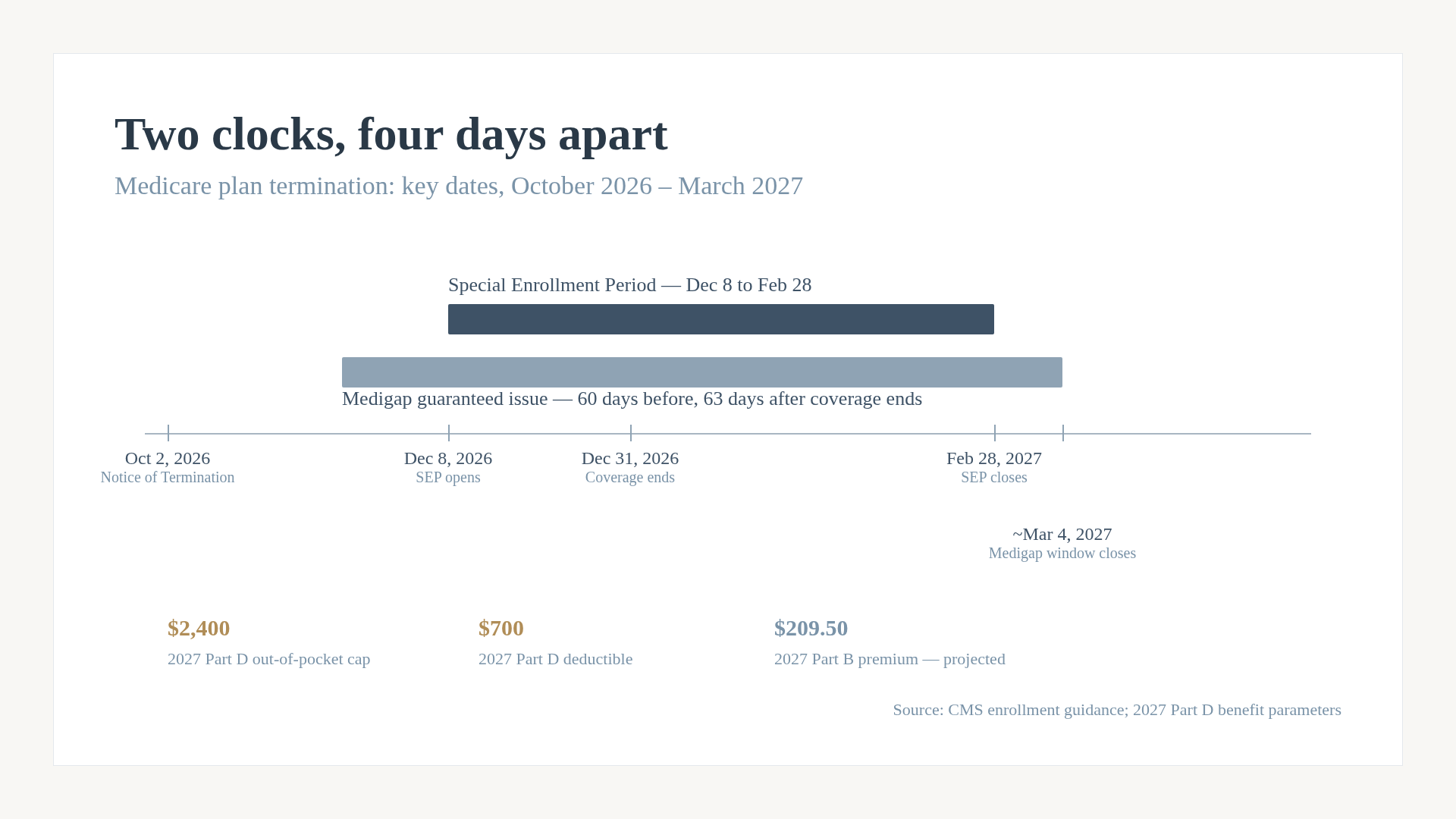
Because your plan is being terminated rather than merely adjusted, Medicare grants you a Special Enrollment Period that runs from December 8, 2026 through February 28, 2027. That is genuinely useful — it extends well past the standard Open Enrollment deadline of December 7 and gives you nearly three additional months to find a replacement Medicare Advantage or Part D plan.
The Medigap clock is governed by different rules. Federal law gives members whose coverage is ending a guaranteed-issue right to buy certain Medicare Supplement policies with no medical underwriting, and that window opens 60 days before your coverage ends and stays open for 63 days afterward. Since the guaranteed-issue period counts from the date coverage actually ends rather than from December 8, a plan terminating on December 31, 2026 leaves that window open until roughly March 4, 2027 — a few days past the February 28 cutoff for switching plans. The practical upshot is that someone who defaults into Original Medicare on January 1 keeps a short buffer to shop for a supplement, but has already forfeited the chance to land in a different Advantage plan instead.
Related: how Medigap guaranteed-issue rights work and the Medicare Open Enrollment calendar.
| By October 2, 2026 — Notice of Termination must reach affected members (confirmed) | |
| October 1, 2026 — Medicare Plan Finder updates with 2027 plan data (confirmed) | |
| October 15 – December 7, 2026 — standard Medicare Open Enrollment (confirmed) | |
| December 8, 2026 — Special Enrollment Period opens for terminated plans (confirmed) | |
| December 31, 2026 — last day to choose for January 1 coverage (confirmed) | |
| February 28, 2027 — Special Enrollment Period closes (confirmed) | |
| Approximately March 4, 2027 — Medigap guaranteed-issue window closes, 63 days after coverage ends (confirmed) | |
| $2,400 — 2027 Part D out-of-pocket cap (confirmed by rule) | |
| $700 — 2027 Part D standard deductible (confirmed by rule) | |
| $209.50 — 2027 standard Part B premium (projected; CMS confirms in November) | |
| Sources | CMS Special Enrollment Period guidance; 2026 Medicare Trustees Report; federal Medigap guaranteed-issue rules |
|---|---|
Why Effective Dates Make February a Bad Month to Decide
The Special Enrollment Period's generous length hides a trap in how effective dates work. A replacement plan selected between December 8 and December 31 begins January 1, seamlessly. A plan selected during January generally does not start until February 1. One selected during February does not start until March 1.
That means a member who uses the full length of the window is not buying more time to be covered — they are buying more time to be uncovered. Prescriptions during a one- or two-month gap may be entirely out of pocket, and while Original Medicare continues paying its share of Part B services throughout, it does so with its deductible and coinsurance and without a supplement absorbing the difference. The window closing February 28 is not the deadline that protects you. December 31 is.
The Part D Penalty Clock Runs Quietly in the Background
There is a third consequence that surfaces years later. Going 63 consecutive days or more without creditable prescription drug coverage triggers a permanent Part D late enrollment penalty of 1 percent of the base beneficiary premium for each uncovered month. The base premium is projected at $41.33 for 2027, so the penalty is modest per month and permanent for life — it follows you into every future drug plan you ever hold.
A member whose Advantage plan ends December 31 and who does not enroll in drug coverage until March has accumulated exactly the kind of gap the rule was written to catch. This is the quietest cost of the do-nothing path and the one people are most surprised by.
Related: why 2027 Medicare Part D is costing more.
Your Four Options
The first is another Medicare Advantage plan in your county, which the termination notice is required to help you identify and which the Plan Finder lists as of October 1. The second is Original Medicare paired with a standalone Part D drug plan, which restores prescription coverage but leaves you without a spending cap. The third is Original Medicare with both a Part D plan and a Medigap policy, which is the most expensive monthly arrangement and the most protective — and the one your guaranteed-issue right briefly makes available without health questions, a door normally locked after your first year on Medicare. The fourth is doing nothing, which is really the second option minus the drug plan.
Which is right depends on your prescriptions, your doctors, and whether your budget tolerates a higher fixed premium in exchange for a lower ceiling on surprises. What does not vary is that the guaranteed-issue window is the only part of this that expires and does not come back.
Related: Medicare Advantage versus Medigap, compared side by side.
Why This Is Happening
Medicare Advantage is sold county by county, and insurers bid against county benchmarks. Where the benchmark no longer supports a profitable bid, exiting the county is the rational business move — which is why the 2027 withdrawals look surgical rather than sweeping. Several national and regional carriers have reduced their 2027 footprints, with reporting suggesting the exits could touch a substantial share of Advantage enrollees nationwide, and rural and lower-density counties absorbing a disproportionate share.
None of that changes your Medicare benefits. It changes which private plans are available to deliver them where you live, and news coverage cannot tell you whether your county is affected. Only your mail can. For everything else shifting next year, see our complete guide to 2027 Medicare changes.
✅What This Means for You
If you are turning 65: this does not apply to you yet, but it is the clearest argument for understanding Medigap guaranteed-issue rules before you choose your first plan — your six-month Medigap open enrollment window at 65 is the widest one you will ever get.
If you are already on Medicare: open every envelope between now and October 2 and determine which letter you received. If it says your plan is ending, put December 31 on the calendar, not February 28.
If you are affected by IRMAA: a move from Medicare Advantage to Original Medicare plus Medigap raises your fixed monthly costs on top of any income-related surcharge you already pay. Model the full monthly figure before you choose, not just the plan premium.
If you are a Medicare Advantage enrollee: you are the group this is aimed at. Even if your plan survives 2027, read the Annual Notice of Change carefully — a plan that continues can still narrow its network or restructure its drug tiers.
Explore Further
Related Medicare Coverage
- What's changing for Medicare in 2027
- Why Is 2027 Medicare Part D Costing More?
- Medicare Open Enrollment dates and deadlines
- Medigap versus Medicare Advantage, compared
Not sure which letter you received or what it obligates you to do? Take the two-minute coverage check.
Not Sure Where You Fit?
Find Your Medicare Path in 60 Seconds
Answer 6 quick questions to see what applies to you — whether you're getting started, managing costs, or comparing plans.
Start the Quick Quiz