In this article8
📋Quick Summary
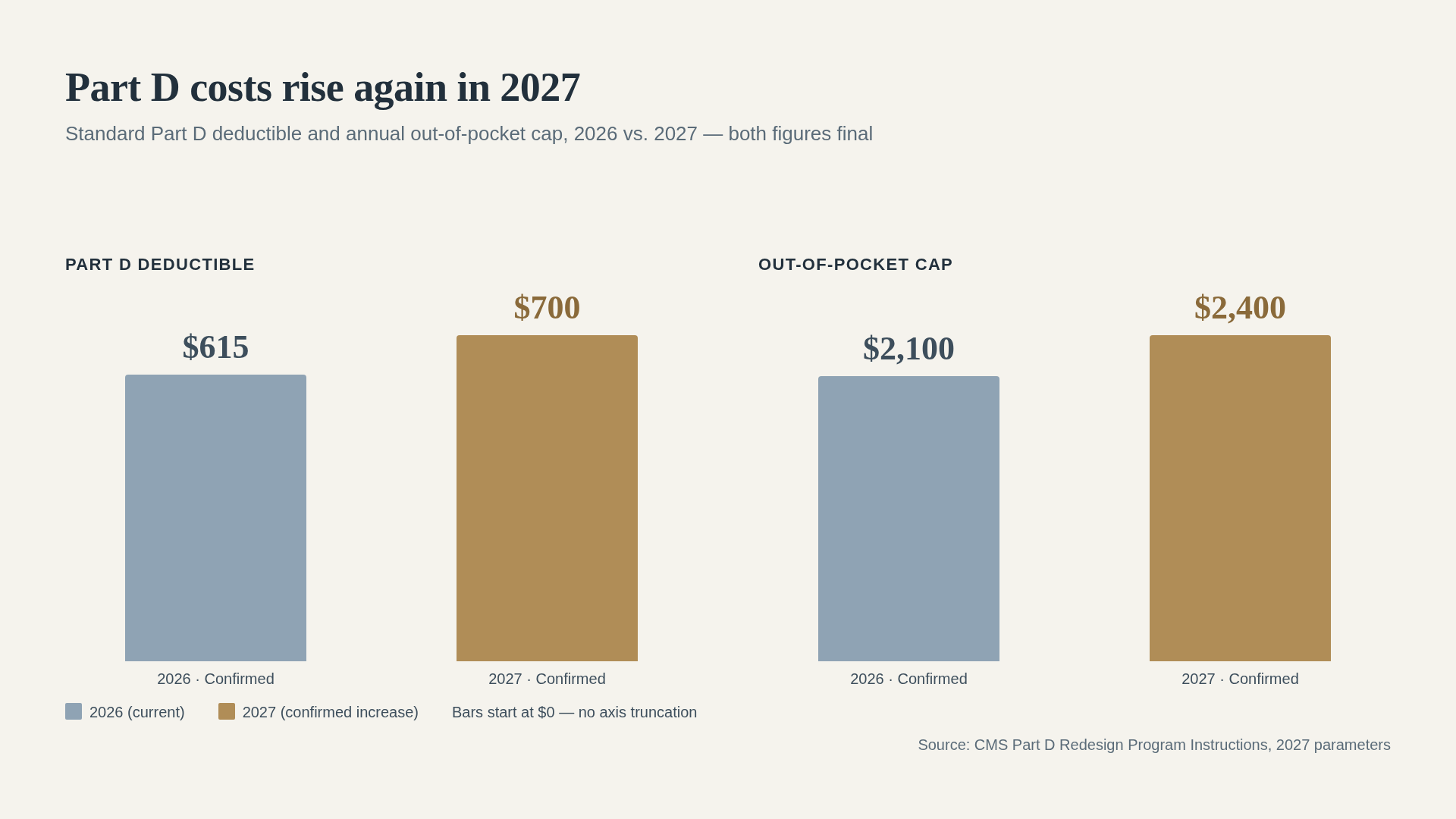
- The standard Part D deductible rises to $700 in 2027, up from $615 — a 13.8% increase.
- The annual out-of-pocket cap rises to $2,400, up from $2,100 — a 14.3% increase.
- A federal program holding standalone drug plan premiums down ends December 31, 2026.
- The $35 insulin cap, $0 recommended vaccines, Extra Help, and the payment plan option all continue unchanged.
- Your actual 2027 premium won't be known until plan data publishes in mid-to-late September.
Two separate things are pushing Part D costs up in 2027, and they get confused constantly because they landed months apart.
The first is routine: the deductible and out-of-pocket cap go up every year under a formula written into the Inflation Reduction Act. Those 2027 numbers were finalized in April 2026 and they are not going to change.
The second is not routine. On July 28, 2026, CMS announced it is ending a temporary program that has been quietly holding down premiums on standalone drug plans since 2025. That program is gone as of January 1, 2027 — and unlike the deductible, nobody yet knows exactly what it will cost you personally.
Here's how to think about both. For everything else changing next year, see our complete guide to 2027 Medicare changes, and for the rules side of 2027 — why your 2027 Medicare sales call could come faster now.
What's confirmed for 2027
CMS finalized these figures in the Contract Year 2027 rate announcement. They apply to the defined standard benefit — the legal minimum a plan may offer. Many plans set a lower deductible or structure their benefit differently, so treat these as the outer boundary, not a prediction of your plan.
| 2026 | 2027 | Change | |
|---|---|---|---|
| Standard deductible | $615 | $700 | +$85 (13.8%) |
| Out-of-pocket cap | $2,100 | $2,400 | +$300 (14.3%) |
| Base beneficiary premium | $38.99 | $41.33 | +$2.34 (6.0%) |
| National average bid amount | $239.27 | $296.05 | +23.7% |
Two of those rows deserve a warning label. The base beneficiary premium is a statutory starting point used to calculate what each plan may charge — it is not your premium. The national average bid amount is an enrollment-weighted average of plan bids used to set the federal subsidy. Nobody pays either number. They get misreported as premiums every single year.
Why the deductible jumped almost 14%
The 2026 deductible rose about 4% over 2025. The 2027 increase is more than three times that. The reason is mechanical rather than political.
Congress tied both the deductible and the out-of-pocket cap to the annual percentage increase in average per-capita Part D spending — not to general inflation, and not to the Social Security COLA. When per-enrollee drug spending accelerates, these thresholds accelerate with it. CMS actuaries projected faster growth for 2027, so both numbers moved sharply.
The practical consequence: if you take ongoing brand-name or specialty medications, you will reach the point where your drugs cost $0 later in the calendar year than you did in 2026, and you'll pay more before you get there.
Related Medicare Updates
Before 2025 there was no ceiling at all on Part D out-of-pocket spending. A specialty drug could run five figures a year with no stopping point. $2,400 is a worse ceiling than $2,100 — and still a categorically different world from no ceiling.
The bigger story: the premium subsidy ends December 31
When the Inflation Reduction Act capped out-of-pocket spending, it shifted a large share of catastrophic drug costs from Medicare onto the insurers running Part D plans. Facing a benefit structure they had never priced before, insurers proposed steep premium increases — particularly on standalone drug plans, the kind people on Original Medicare buy alongside a Medigap policy.
To prevent that, CMS created the Part D Premium Stabilization Demonstration for the 2025 plan year. It worked two ways: it reduced the base beneficiary premium used in plan pricing, and it capped how much any single plan's premium could rise year over year.
| Plan year | Base premium reduction | Max allowed premium increase |
|---|---|---|
| 2025 | $15 | $35 |
| 2026 | $10 | $50 |
| 2027 | None — program ended | No cap |
Nearly every standalone plan sponsor opted in, which is why removing it is a market-wide event rather than a niche one. The program cost roughly $9.8 billion across its two years. CMS's stated rationale for ending it early is that after reviewing 2027 bids, insurers now have enough experience with the redesigned benefit to price without federal support.
How much more will you actually pay?
This is where honest sources diverge, and you should know that going in.
CMS Administrator Dr. Mehmet Oz has said most beneficiaries will see increases under $10 a month, with some paying less than they do now. KFF's analysis is less sanguine: roughly 45% of standalone enrollees are projected to see increases of $11 to $20 a month, while about 25% could stay flat or drop. A February 2026 GAO report found that without the subsidy, beneficiaries who stayed in their 2024 plan would have seen premiums nearly double.
All three can be true — the effect is uneven by plan and by region. What matters is that no one can tell you your number yet. Not CMS, not your agent, not your current plan's service line. Final 2027 plan pricing publishes in mid-to-late September.
People on Original Medicare with a standalone Part D plan — roughly 25 million enrollees. If you have Medicare Advantage with drug coverage built in, this change largely does not reach you. If you receive Extra Help, it does not reach you either: you already pay no premium and no deductible.
What is not changing in 2027
The July announcement produced a wave of alarming headlines. To be clear about what survives intact:
- The out-of-pocket cap itself. It rises to $2,400 but it is not going anywhere. Hit it and covered drugs cost you $0 for the rest of the year.
- The $35 insulin cap. Continues for a month's supply.
- $0 recommended adult vaccines. Continues, and remains exempt from the deductible.
- Extra Help (the Low-Income Subsidy). Not ending. Not reduced.
- No coverage gap. The donut hole was eliminated in 2025 and stays eliminated.
- The Medicare Prescription Payment Plan. Still available, and if you enrolled in 2025 or 2026 you are automatically re-enrolled for 2027 unless you opt out or change plans.
Negotiated drug prices arrive January 1
Working in the other direction: the second round of Medicare-negotiated prices takes effect January 1, 2027, covering 15 more Part D drugs. Discounts range from 38% to 85%.
The headline is semaglutide — Ozempic, Rybelsus, and Wegovy — dropping to $274 for a 30-day supply from a $959 list price, a 71% cut. Because negotiation requires formulary placement, Wegovy's Part D coverage expands substantially in 2027 after years of restriction.
One caution that gets lost in the coverage: a negotiated price is what Medicare and your plan pay the manufacturer. Your copay depends on your plan's design, your tier, and which benefit phase you're in. A 71% cut to the negotiated price does not mean a 71% cut at your counter.
How the three phases work in 2027
Part D runs in three stages now, not four:
- Deductible. You pay 100% of covered drug costs until you hit your plan's deductible — up to $700 under the standard benefit.
- Initial coverage. You and your plan share costs. Under the standard benefit that's 25% coinsurance.
- Catastrophic. Once your true out-of-pocket spending reaches $2,400, you pay $0 for covered drugs for the rest of the calendar year.
Worth knowing: your deductible spending counts toward the $2,400. And if you switch plans mid-year under a qualifying circumstance, your accumulated out-of-pocket total travels with you.
What to do, and when
| Date | What happens |
|---|---|
| By Sept 30, 2026 | Your Annual Notice of Change arrives — read it |
| Mid-to-late Sept | CMS publishes final 2027 plan premiums |
| Oct 1, 2026 | 2027 plan data goes live in Medicare Plan Finder |
| Oct 15 – Dec 7 | Annual Enrollment Period |
| Jan 1, 2027 | New pricing and negotiated drug prices take effect |
Your Annual Notice of Change is the single document that answers the question this article can't: what your specific plan will cost. Three things to check when it arrives — your premium, whether your prescriptions are still on the formulary, and whether any of them moved to a higher tier or picked up a prior authorization requirement.
✅The Bottom Line
The deductible and cap increases are locked in and modest in absolute terms. The premium subsidy ending is the change worth your attention, and it lands hardest on people with Original Medicare and a standalone drug plan. You cannot act on it yet — the numbers aren't public. What you can do is put mid-September on your calendar and commit to actually comparing plans this year rather than letting yours auto-renew. Auto-renewal is the expensive default in a year like this one.
Explore Further
Sources
- CMS — Medicare Part D 2027 National Average Monthly Bid Amount fact sheet (July 28, 2026)
- CMS — CY2027 Medicare Advantage and Part D Rate Announcement (April 2026)
- CMS — Contract Year 2027 MA and Part D Final Rule, Federal Register (April 6, 2026)
- CMS — Selected Drugs and Negotiated Prices, Initial Price Applicability Year 2027
- KFF — Analysis of the end of the Part D premium stabilization demonstration (July 29, 2026)
- GAO — Report on the Part D Premium Stabilization Demonstration (February 2026)
- Medicare.gov — Medicare Prescription Payment Plan fact sheet