In this article4
A one-time $90 payment is headed to about 20.8 million people on Medicare, and a much larger group won't see any of it. President Trump announced the Medicare Improvement Fund Premium Rebate on October 2, 2026, and CMS published the rules the next day. Most eligible people will get a direct deposit on or around October 8, 2026, and CMS's FAQ lists no application. The catch is who qualifies: anyone in a Medicare Advantage plan is out, and CMS limits the rest to people in Original Medicare Part B who don't get Medicaid premium help and don't pay an IRMAA surcharge. Below is what CMS has confirmed, where the rules are still unclear, the debate in Washington over the payment, and how to tell the real payment from the scams that announcements like this tend to attract.
📋Quick Summary
- A one-time $90 Medicare Improvement Fund Premium Rebate is going to about 20.8 million people, according to CMS's FAQ published October 3, 2026
- Eligible: people in Original Medicare Part B who live in the U.S., don't get Medicaid premium assistance, and don't pay IRMAA. Medicare Advantage enrollees are not eligible
- Most direct deposits, from the Social Security Administration, are due on or around October 8, 2026, with an email or letter from the President in mid-October. Some people get a Treasury check later in October
- CMS's FAQ lists no application step, so anyone asking you to apply, pay, or confirm bank or Medicare numbers to “claim” the $90 is not following the process CMS describes
- 20.8 million is about a third of the roughly 62.9 million people with Part B. STAT, citing KFF, reports that more than half of eligible Medicare beneficiaries are in Medicare Advantage.
- $90 equals about 44% of one month's standard 2026 Part B premium ($202.90) and about 3.7% of a year's ($2,434.80)
- Democrats have questioned whether the payment is legal without congressional approval, and no court has blocked it, according to Scripps News on October 5, 2026. CMS describes it as a use of the fund's purpose
- Check eligibility at 1-800-MEDICARE; check payment status with Social Security at 1-800-772-1213 starting October 15, 2026
What CMS has confirmed about the $90 payment
The payment's official name is the Medicare Improvement Fund Premium Rebate. According to CMS's FAQ, eligible people will receive a single $90 rebate in October 2026, described as a payment to offset October's Part B premium. It is not a monthly benefit, and nothing in the FAQ changes what Part B costs going forward.
CMS describes the recipients as 20.8 million people in Original Medicare Part B who live in the United States and who aren't getting premium help from Medicaid or paying an Income-Related Monthly Adjustment Amount (IRMAA). People enrolled in Medicare Advantage are not eligible. The FAQ strings those conditions together with an "or," which reads ambiguously. CNN's reporting, carried by Yahoo News, reads them the way most coverage does: people whose Part B premiums Medicaid helps with, and higher-income people who pay IRMAA, are both left out. If you're in either group and aren't sure, call 1-800-MEDICARE rather than guessing.
On timing, most eligible people will get a direct deposit from the Social Security Administration on or around October 8, 2026, followed by an email or a letter from the President in mid-October. People without direct deposit will get a paper check from the U.S. Treasury later in October, mailed to the address registered with Medicare, with the message "Medicare Improvement Fund Payment; $90 Payment to Offset October Premium." CMS's FAQ doesn't say how the deposit will appear on a bank statement. To ask whether you're eligible, call 1-800-MEDICARE (1-800-633-4227). To ask about the status of a payment, call Social Security at 1-800-772-1213, which CMS says you can do starting October 15, 2026.
One thing the FAQ doesn't address is taxes. If you have questions about how the payment affects your return, ask a tax professional or the IRS. We'll update this page as CMS adds guidance.
Sources: CMS Medicare Improvement Fund Premium Rebate FAQ; Kiplinger; Yahoo News, citing CNN
CMS's FAQ describes no application, no form, and no sign-up. Eligible people receive the money by direct deposit from the Social Security Administration or by a Treasury check mailed to the address Medicare already has. Any call, text, email, or website that asks you to apply, pay a fee, "verify" your bank account, or give your Medicare or Social Security number so you can "claim" the $90 is not following the process CMS describes.
CMS says most people will also get an email or a letter from the President in mid-October. The FAQ doesn't describe what that message will say, so treat any message about the payment that asks you to click, call, pay, or confirm account details as suspect, whoever's name is on it. Check eligibility with 1-800-MEDICARE and payment status with Social Security at 1-800-772-1213 starting October 15, 2026. Use the numbers CMS published at cms.gov, not a number in a message that reached you.
Who's left out, and what's still unclear
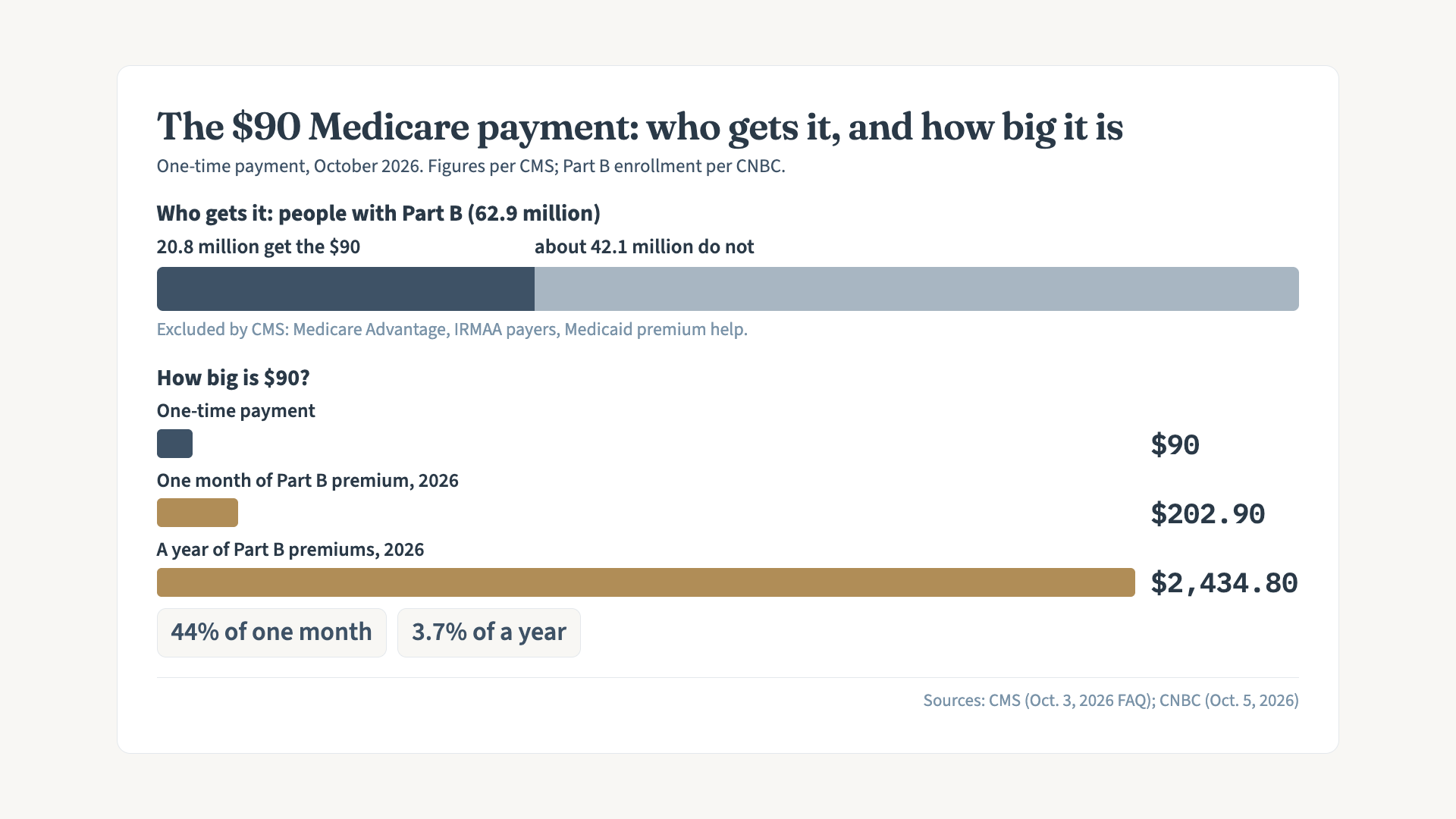
Start with the scale. CMS counts about 62.9 million people with Part B, according to CNBC, so the 20.8 million who qualify are roughly a third of everyone with Part B. By our arithmetic, that leaves about 42.1 million people with Part B outside this round of payments.
The largest group left out is Medicare Advantage. STAT, citing KFF, notes that more than half of eligible Medicare beneficiaries are in Medicare Advantage, and most Medicare Advantage members still pay the Part B premium to Medicare unless their plan covers some of it through a giveback benefit. CMS's FAQ states the exclusion without explaining it; the only context it offers is that Congress created the Medicare Improvement Fund to finance improvements to Original Medicare's fee-for-service program. If you're in Medicare Advantage, KFF Health News reports that at least 2 million Medicare Advantage members will get notices this fall that their plans will end at year's end. Our report on where 2027 plan options are shrinking covers that side of the story.
The other two exclusions are about income. IRMAA is the surcharge higher earners pay on top of the standard Part B premium; our IRMAA income brackets guide explains the thresholds. People whose state pays their Part B premium through a Medicare Savings Program are the Medicaid-premium-help group. Those programs run through state Medicaid offices, so if your state pays your premium you are very likely excluded, and our guide to help with Medicare premiums explains how they work.
Some situations are less clear. CMS's FAQ doesn't say how people who recently enrolled in Part B are treated, so if your situation is unusual, call 1-800-MEDICARE before assuming either way. And don't change plans to chase this payment. Changes you make during Annual Enrollment, which runs October 15 through December 7, 2026, take effect January 1, 2027, long after the October payment, and nothing in CMS's FAQ suggests switching would qualify you. Pick your 2027 coverage on what it will cost and cover for a full year; our guide to switching Medicare plans covers the rules.
Sources: CNBC; STAT; KFF Health News; CMS FAQ
Related Medicare Updates
✅What This Means For You
If you're turning 65 this year: You need to be enrolled in Original Medicare Part B to be in the group CMS describes. The FAQ doesn't say how recent enrollees are handled, so ask 1-800-MEDICARE rather than assuming you'll get the $90. Don't let it drive your plan choice.
If you're already on Medicare: If you're in Original Medicare Part B, pay your own premium, and don't pay IRMAA, expect a direct deposit on or around October 8, 2026, or a check later in October. You don't need to do anything, and you shouldn't give anyone your bank or Medicare number to "claim" it. Make sure the mailing address Medicare has for you is current.
If IRMAA affects you: CMS describes people who pay IRMAA as outside this payment, and the $90 doesn't change your surcharge. If you think you were excluded by mistake, call 1-800-MEDICARE to confirm. Our IRMAA income brackets guide explains how the surcharge works.
If you're on Medicare Advantage: CMS says you're not eligible. Annual Enrollment runs October 15 through December 7, 2026, with changes starting January 1, 2027. Use it to compare plans on 2027 costs and benefits, not on a one-time $90. See Will You Have Any 2027 Medicare Advantage Options?
Explore Further
The debate over the payment, and how big $90 really is
CMS's FAQ frames the payment as returning healthcare dollars to beneficiaries and making coverage more affordable. It says CMS is using the Medicare Improvement Fund, which Congress created in 2008 to finance improvements to Original Medicare, for the first time to make the program more affordable for enrollees. It adds that Congress has withdrawn money from the fund around 20 times to offset new spending, citing a Congressional Budget Office report, and points to a $20.7 billion withdrawal in 2010 as an example.
Critics have raised questions. Scripps News reports that Democrats are questioning whether the payments are legal because Congress didn't approve them, and that no court has blocked them so far. KFF's Larry Levitt told STAT that previous administrations haven't used the fund this way, although Congress has periodically taken money out of it for other priorities. STAT also noted the announcement came about a month before the November 3 midterm elections. CMS's FAQ quotes the fund's statutory purpose but doesn't lay out a legal analysis. These are open questions, not settled findings, and we're not taking a side. What matters for you is what's confirmed about eligibility and timing.
On size, the payment is modest next to what Part B costs. CNBC reports that the standard 2026 Part B premium is $202.90 a month, or $2,434.80 for the year, so $90 equals about 44% of one month's premium and about 3.7% of a year's. CNBC also notes the 2027 premium is estimated at $209.50. If that holds, the increase is $6.60 a month, or $79.20 over a year, close to the size of the rebate, with one difference: the rebate is a single payment, while the premium increase repeats every year. We break down the 2027 numbers in Will Your 2027 Social Security Raise Beat Medicare's Increase?
Reports put the fund's size at roughly $2 billion to $2.2 billion: the White House has described it as $2 billion, while CNN reported that Congress created it with $2.2 billion. At 20.8 million payments of $90, the rebate would cost about $1.87 billion by our arithmetic, which would use most of the fund. CMS hasn't said what remains afterward.
Sources: CMS FAQ; Congressional Budget Office; Scripps News; STAT; CNBC; Money Overview; Yahoo News
How to tell the real payment from a scam
As of October 6, 2026, we haven't found a published warning about scams using this specific payment, but that doesn't mean it's safe. Announcements of government money reliably attract impersonators, and there's recent precedent for scammers borrowing political names. In February 2026, North Carolina's SHIIP program warned about callers pitching a bogus "Trump Medicare program" with monthly grocery cards, and the National Council on Aging lists politically branded ads with phony endorsements among current tactics.
Five checks separate the real payment from a fake one. First, CMS's FAQ lists no application, so anyone telling you to apply or sign up is off script. Second, the real money arrives by direct deposit from Social Security or a Treasury check, and no one needs you to pay anything, by gift card, wire transfer, or app, to receive it. Third, nobody who contacts you first needs your Medicare number, Social Security number, or bank details to "release" the $90. The FTC says Medicare won't call, text, or email out of the blue asking for your numbers or a payment, and that caller ID can be faked. Fourth, don't click links or call numbers in a text or email about the payment; go to cms.gov or Medicare.gov yourself. Fifth, check status only through the numbers CMS published: 1-800-MEDICARE, and Social Security at 1-800-772-1213 starting October 15, 2026.
If you're contacted about the payment and the contact asks for anything, hang up or delete it and report it. Call 1-800-MEDICARE, then tell the FTC at ReportFraud.ftc.gov. Your local Senior Medicare Patrol can help, and so can the free counselors in our state SHIP directory. Our guide to Medicare scam calls covers the warning signs.
A short checklist before October 15, 2026: confirm whether you're in the eligible group; make sure the mailing address Medicare has for you is current, since that's where a paper check goes; expect either a direct deposit on or around October 8, 2026 or a check later in the month; and don't change your bank information with anyone because of a message about this payment. We'll update this page when CMS confirms the deposits have gone out and if it adds eligibility guidance.
Sources: FTC; National Council on Aging; North Carolina SHIIP alert; CMS
Common questions about the $90 Medicare payment
- Do I need to apply for the $90 Medicare payment?
- CMS's FAQ lists no application step. Eligible people are to receive it by direct deposit from the Social Security Administration or a Treasury check. Anyone asking you to apply, pay a fee, or confirm your bank or Medicare number to “claim” it is not following the process CMS describes.
- When will the $90 Medicare payment arrive?
- CMS says most people will get a direct deposit on or around October 8, 2026, followed by an email or letter from the President in mid-October. Some people will get a paper check from the U.S. Treasury later in October.
- Is the $90 a monthly payment?
- No. CMS describes a single rebate in October 2026 to offset the October Part B premium. Nothing in CMS's FAQ changes what Part B costs.
- Do Medicare Advantage members get the $90?
- No. CMS says people enrolled in Medicare Advantage are not eligible.
- Do I get the $90 if I pay IRMAA or get help with my Part B premium from Medicaid?
- CMS limits eligibility to people in Original Medicare Part B who aren't getting Medicaid premium assistance or paying IRMAA, and news coverage reads that as excluding both groups. If you're unsure, call 1-800-MEDICARE (1-800-633-4227).
- How do I check my eligibility or payment status?
- Call 1-800-MEDICARE (1-800-633-4227) to check eligibility. To check payment status, call the Social Security Administration at 1-800-772-1213 starting October 15, 2026.
- Is the $90 Medicare payment taxable?
- CMS's FAQ doesn't address taxes. Ask a tax professional or the IRS.
| October 2, 2026 | Payment announced |
|---|---|
| October 3, 2026 | CMS publishes its FAQ |
| On or around October 8, 2026 | Most direct deposits from Social Security |
| Mid-October 2026 | Email or letter from the President |
| October 15, 2026 | Social Security status line opens; Annual Enrollment begins |
| Later in October 2026 | Paper checks from the U.S. Treasury |
| December 7, 2026 | Annual Enrollment ends |
| January 1, 2027 | Plan changes made during Annual Enrollment take effect |
Answer six quick questions to see which Medicare path matches your health, budget, and timing — Find Your Medicare Path in 60 Seconds →