In this article4
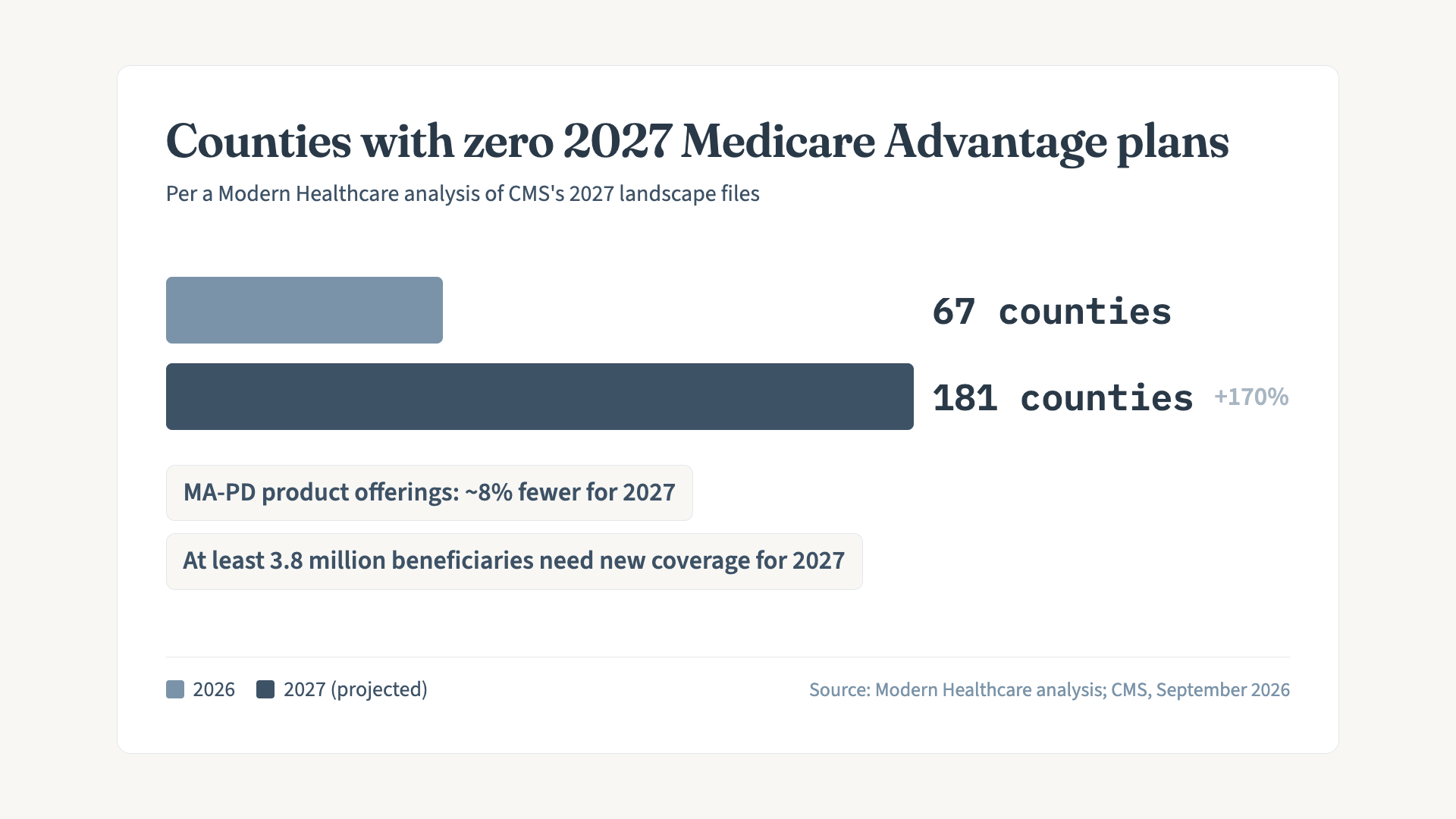
Yesterday's headline was the good news: Medicare Advantage premiums are projected to fall for 2027, on average, across the country. Today's data tells the other half of the story. According to a Modern Healthcare analysis of CMS's newly released 2027 landscape files, 181 counties will have zero Medicare Advantage plans available next year, up from 67 this year — a 170% jump in places where the program simply won't exist as an option. Individual plan offerings are shrinking too, even though the total plan count looks nearly flat. And starting tomorrow, October 1, insurance agents are legally allowed to start calling about specific 2027 plans. Here's what the new county-level data actually shows, and what to check regardless of whether your own area is affected.
📋Quick Summary
- 181 U.S. counties will have zero Medicare Advantage plans in 2027, up from 67 in 2026 — a 170% increase, per a Modern Healthcare analysis of CMS's 2027 landscape files
- Individual Medicare Advantage plans that include Part D drug coverage (MA-PD products) are projected to decline about 8% in 2027
- Total MA plan count looks nearly flat, 5,553 in 2026 to about 5,532 in 2027 — the county and product-level detail is what that aggregate number hides
- At least 3.8 million beneficiaries are expected to need new coverage for 2027 after their current plan is terminated; 2026's comparable impact was estimated at 2.9 to 4.6 million across various analyses
- CMS itself projects overall MA enrollment will fall from 36.3 million to 34 million in 2027 — though insurers made a similar prediction for 2026 that didn't happen
- CMS's April 2026 guidance now lets insurers build enrollment caps into specific 2027 plans — a capped plan can close to new members mid-year, but cannot disenroll people already on it
- Agents cannot legally discuss specific 2027 plans or collect a Scope of Appointment before October 1, 2026 — tomorrow
- None of this changes the September 30 ANOC deadline or the October 15 to December 7 enrollment window
What "181 counties with zero plans" actually means
The topline 2027 Medicare Advantage numbers look stable at first glance. CMS itself projects the total number of plans offered nationally will fall only slightly, from 5,553 in 2026 to about 5,532 in 2027 — a number small enough to read as "roughly unchanged." A Modern Healthcare analysis of the same underlying landscape files found something the aggregate number obscures: 181 counties will have no Medicare Advantage plan available at all in 2027, up from 67 counties this year. That's a 170% increase in places where the program isn't declining in quality or price — it simply isn't there.
The same analysis found that individual MA-PD products, meaning specific Medicare Advantage plans that bundle in Part D drug coverage, are projected to decline about 8% nationally for 2027. A market can lose a meaningful share of its specific plan offerings while the total plan count stays almost flat, if insurers are simultaneously adding plans in some areas while withdrawing from others. That's consistent with the pattern described in our earlier look at why 2027 Medicare Advantage benefits are still shrinking: insurers reported to be cutting the most, including Humana and UnitedHealthcare, are also among those pulling back from specific counties and product lines, even as the market overall looks stable in aggregate.
Sources: Healthcare Labyrinth, September 29, 2026, citing Modern Healthcare analysis of CMS's 2027 MA landscape files; CMS press release, September 28, 2026.
If your county is one of the 181, it does not mean you lose Medicare coverage. Original Medicare, Parts A and B, remains available everywhere in the country, with no county-level exceptions. A county with zero Medicare Advantage plans simply means the private-plan alternative isn't offered there for 2027 — Original Medicare, paired with a standalone Part D plan and optionally a Medigap supplement, is still fully available. If you're currently on a Medicare Advantage plan in a county that's losing all its options, your plan's non-renewal would trigger a Special Enrollment Period and a guaranteed-issue right to buy Medigap without medical underwriting, the same protection covered in our guide on what happens if your 2027 plan is cancelled.
Why some places are losing options while the national numbers look fine
The gap between the national premium story and the county-level story comes down to how insurers are making individual, market-by-market decisions rather than applying a uniform national strategy. A national weighted average premium, like the 16.5% decrease CMS announced for 2027, reflects enrollment shifting toward lower-cost plans in aggregate. It says nothing about whether any specific county still has a competitive set of plans to choose from. An insurer can simultaneously cut prices in markets it wants to grow and withdraw entirely from markets it considers unprofitable, and both moves show up in the same national data release without contradicting each other.
CMS's own enrollment projection adds another layer. The agency expects total Medicare Advantage enrollment to fall from 36.3 million in 2026 to 34 million in 2027 — a meaningful projected decline. It's worth holding that number with some skepticism, though: insurers made a similar prediction ahead of the 2026 plan year that did not come to pass, and enrollment projections built into landscape files reflect what insurers filed, not a guarantee of what beneficiaries will actually choose. Still, the combination of a projected enrollment decline, a rising count of coverage-desert counties, and a real decline in individual product offerings is a more cautious signal than the premium headline alone suggests.
There's a new regulatory piece to this too. CMS's April 2026 guidance allows insurers to build enrollment caps directly into their 2027 plan bids — meaning a specific plan can be designed from the outset to stop accepting new members once it hits a set threshold, partway through the year. That guidance was reinforced again in CMS's August 2026 communication to MA payers. The protection built into this rule is that a capped plan cannot disenroll members who are already on it; the cap only affects new enrollment. But it means that during Annual Enrollment this fall, a plan that looks available today could close to new members before you act if you wait too long, which is a more concrete version of the enrollment-timing caution we raised in yesterday's premiums and plan choice coverage.
Sources: Ermer and Suter PLLC, "Tuesday report," September 29, 2026; CMS press release, September 28, 2026; Healthcare Labyrinth, September 29, 2026.
Related Medicare Updates
✅What This Means For You
If you're turning 65 this year: Ask directly, when comparing plans, whether your specific county has a competitive set of options or whether the market looks thin. A single-digit number of plans, or a market that recently lost a major insurer, is worth factoring into whether Original Medicare plus a Medigap supplement makes more sense than Medicare Advantage where you live.
If you're already on Medicare Advantage: If your plan is terminated for 2027, you'll get a Special Enrollment Period and guaranteed-issue Medigap rights — but only if your specific plan is actually discontinued, not merely because the county-level market has gotten thinner. Watch your Annual Notice of Change, due by September 30, for a discontinuation notice specifically.
If IRMAA affects you: County-level plan availability and enrollment caps don't affect your IRMAA surcharge, which is based on income. But if a thinning local market pushes you toward Original Medicare plus Medigap, the predictable monthly cost of that combination is worth comparing against your IRMAA-adjusted Medicare Advantage premium either way.
If you're comparing Medicare Advantage plans this fall: Don't wait until early December to act on a plan you're interested in. With CMS now permitting mid-year enrollment caps on specific 2027 plans, a strong option in your area could close to new enrollees before Annual Enrollment even ends. Starting tomorrow, October 1, is also the first day agents can legally discuss specific 2027 plans with you at all, so expect outreach to begin picking up.
Explore Further
What starts tomorrow, and why the timing matters
October 1 is a fixed date on the Medicare marketing calendar every year: it's the first day insurance agents and plans are permitted to discuss specific plan benefits for the coming year, or collect a Scope of Appointment, the form that authorizes a one-on-one sales conversation. This rule isn't new for 2027 — it's the standing annual calendar CMS enforces industry-wide — but it's worth naming plainly given how much 2027-specific outreach is about to start. If you get a call about a specific 2027 plan before October 1, that's a compliance violation worth reporting, not routine early outreach.
Once that window opens, the volume of contact tends to increase quickly, and this year it's opening alongside a genuinely more complicated market than usual: national premiums reported to be falling, specific insurers reported to be cutting benefits, county-level coverage deserts expanding, and mid-year enrollment caps now a real possibility on specific plans. An agent's pitch about a specific plan's affordability doesn't tell you whether that plan exists in a market that's otherwise thinning, or whether it's one of the plans built with an enrollment cap. Asking directly — "is this plan capped, and if so, what's the cap" and "how many other Medicare Advantage plans are actually available in my specific county for 2027" — are reasonable, specific questions this year in a way they weren't in past years with a more stable landscape.
Source: SelectHealth Medicare agent bulletin, September 2026, on the CMS 2027 marketing and Scope of Appointment calendar.
How to actually check your own county
The county-level detail in this story is exactly the kind of thing that's easy to read about nationally and hard to apply to yourself without a specific tool. A few concrete steps close that gap.
Use Medicare.gov's Plan Finder and enter your specific ZIP code once the full 2027 plan data is publicly searchable there. It will show you exactly how many Medicare Advantage plans, if any, are available where you live — not a national average, not a regional estimate, but your actual county's options.
If your county turns out to be one with zero Medicare Advantage plans for 2027, or a market that's shrunk sharply, start pricing Original Medicare plus a Medigap policy now rather than waiting until Annual Enrollment opens. Our Medigap guaranteed-issue coverage and switching plans guides cover the mechanics and timing.
If you're staying on Medicare Advantage and found a plan you like, don't delay enrolling once Annual Enrollment opens October 15, given that some 2027 plans may carry enrollment caps that trigger before December 7.
And if any of this feels like more to track than you want to manage alone, a State Health Insurance Assistance Program counselor can look up your specific county's 2027 options with you and help you understand whether your market is one of the ones getting thinner. Find yours at our SHIP directory.
We'll revisit this page once the complete county-by-county 2027 landscape data is fully public and searchable.
Sources: Medicare.gov Plan Finder; State Health Insurance Assistance Program network.
Table 1 — 2027 Medicare Advantage landscape, national vs. local detail
| Metric | 2026 | 2027 (projected) | Change |
|---|---|---|---|
| Total MA plans offered nationally | 5,553 | ~5,532 | roughly flat |
| Counties with zero MA plans available | 67 | 181 | +170% |
| MA-PD product count | baseline | ~8% fewer | declining |
| CMS-projected MA enrollment | 36.3 million | 34 million | CMS projection; 2026 prediction of decline did not materialize |
| Beneficiaries needing new coverage | 2.9–4.6 million (various 2026 estimates) | at least 3.8 million | — |
Table 2 — Key 2027 dates
| Date | What happens |
|---|---|
| September 30, 2026 | Annual Notice of Change deadline |
| October 1, 2026 | Agents may begin discussing specific 2027 plans, collecting Scopes of Appointment |
| October 15, 2026 | Annual Enrollment Period opens |
| December 7, 2026 | Annual Enrollment Period closes |
| January 1, 2027 | 2027 coverage, and any enrollment caps, take effect |
Sources: Modern Healthcare analysis via Healthcare Labyrinth; CMS press release, September 28, 2026; SelectHealth agent bulletin.
Answer six quick questions to see which Medicare path matches your health, budget, and timing — Find Your Medicare Path in 60 Seconds →