In this article4
A text arrives saying you qualify for a Medicare benefit card worth thousands of dollars for groceries, gas and utilities. Another says your paper Medicare card is expiring and you can request a new plastic chip card at no cost. Both want you to reply or tap a link. As of October 6, 2026, neither matches how Medicare delivers benefits, and the timing matters: Medicare's Annual Enrollment Period runs October 15 through December 7, and the FTC has warned about scams during that season. This guide covers what real benefit cards are, how the fake offers are built, four checks that take under a minute, and what to do if you already replied.
📋Quick Summary
- Unsolicited texts offering a Medicare "benefit card" or a "new plastic chip card" are not Medicare communications. The FTC says true Medicare representatives won't call, text, or email you out of the blue to ask for your numbers or a payment.
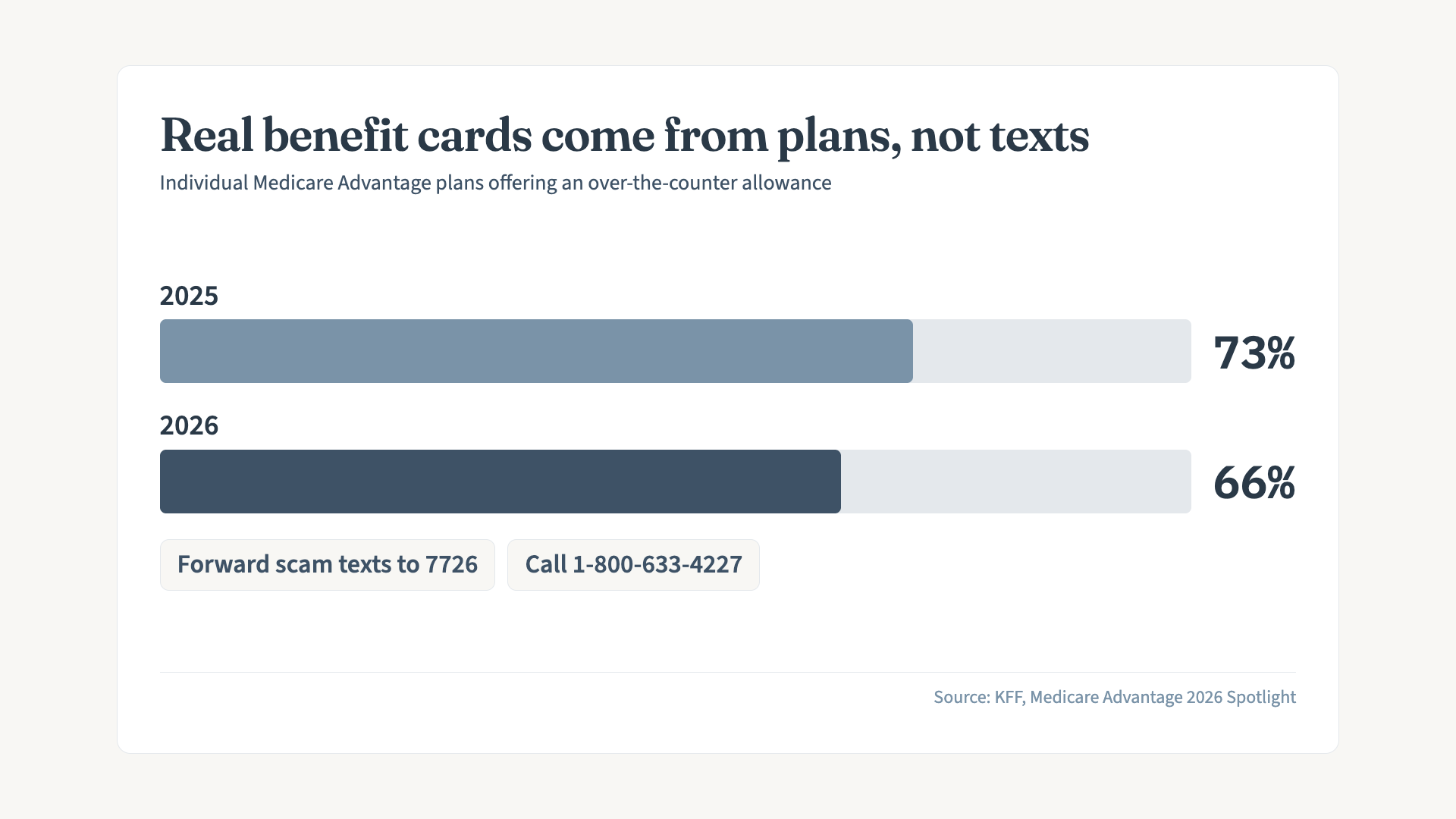
- Real benefit cards exist, but they come from a Medicare Advantage plan after you enroll. KFF found 66% of individual Medicare Advantage plans offering an over-the-counter allowance in 2026, down from 73% in 2025.
- Do not reply or tap links. Forward the text to 7726 and report it at ReportFraud.ftc.gov.
- Annual Enrollment runs October 15 through December 7, so expect more of these texts and calls. Use 1-800-MEDICARE (1-800-633-4227), not the number in a text.
Do Real Medicare Benefit Cards Exist?
Yes, but they work differently from the texts. Many Medicare Advantage plans load a dollar allowance onto a card for over-the-counter items and, on some plans, other supplemental benefits. KFF describes these allowances as often loaded onto a flex card or spending card that works at participating stores. KFF found 66% of individual plans offering an over-the-counter allowance in 2026, down from 73% in 2025. KFF's count covers individual plans, which excludes employer-group and special-needs plans.
Two things follow from that. First, the card belongs to one specific plan, so only that plan can issue it, and only after you are enrolled. Second, the amount, the store list and the eligible items are set plan by plan. Our guide to why a flex card gets declined at Walmart shows how restrictive those lists can be. Original Medicare, Part A and Part B, has no benefit card at all.
A benefit card is tied to a plan you have joined. A text from a number you do not know cannot issue one, because only your plan can.
What Do the Fake Offers Look Like in October 2026?
Three patterns account for most of what readers send us. The first is the big-dollar senior card. Many of these texts come from the short code 42474, carry the CenturyMed name, and promise a card worth $2,600, or $4,200, or a different figure each time, for food, gas and utilities. Our guide explains that the dollar amounts appear to be several plan allowances added together across a full year, and that replying CARD does not produce a card. It produces contact, typically an insurance sales call. The full breakdown is in our guide to the 42474 texts.
The second is the "new plastic chip card." These texts say paper Medicare cards are expiring and invite you to tap a link to request a plastic card at no cost. As of October 6, 2026, we found no CMS announcement of a plastic or chip Medicare card. CMS's card-scam alert from the 2018 card reissue says replacement cards are free and that nobody representing Medicare will ask for your personal information for you to get one. For legitimate reasons you might get a new card in the mail, see Why Did You Get a New 2026 Medicare Card in the Mail?
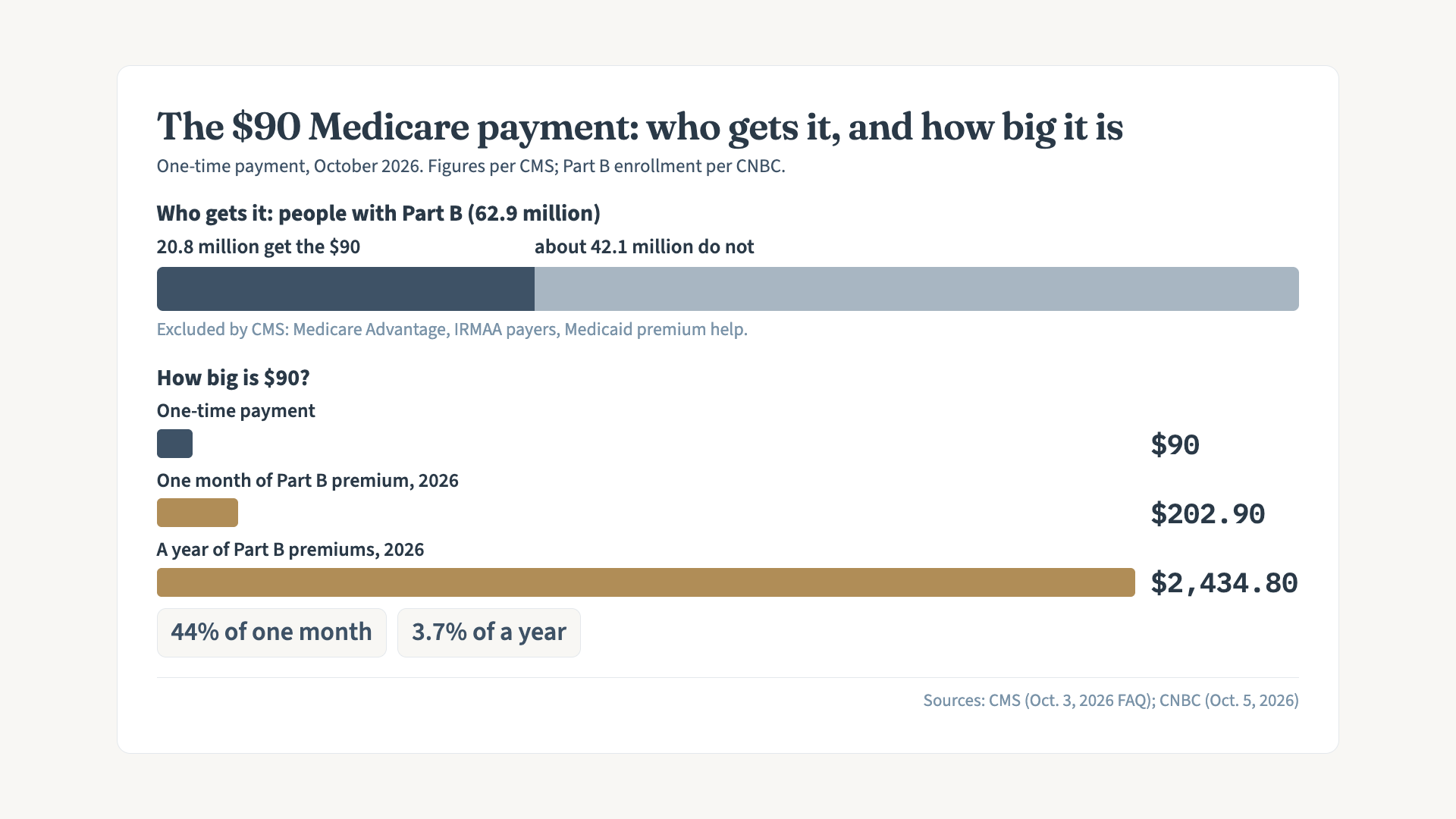
The third borrows real headlines. Scammers attach themselves to real news, including the one-time $90 payment going out in October 2026. We found no published warning about a $90 payment scam as of October 6, but our guide explains how to tell the real $90 Medicare payment from a scam.
Related Medicare Updates
Four Checks That Take Under a Minute
Check 1, who is it from? Medicare.gov says Medicare will never call you to sell you anything or visit you at your home, and the FTC says true Medicare representatives won't text out of the blue to ask for your numbers or a payment. A text that mentions Medicare proves nothing. The FTC also cautions that names and caller ID can be faked.
Check 2, what does it ask you to do? A keyword reply like CARD, a link to tap, or a request for your Medicare number, Social Security number or bank details is a reason to stop. CMS's 2018 card-scam alert lists unsolicited requests for those numbers, demands for payment and threats to cancel your benefits as red flags.
Check 3, where does the link go? Official Medicare addresses end in .gov, such as Medicare.gov. Look-alike domains imitate them, so type the address yourself instead of tapping a link in a text.
Check 4, is there pressure? Dollar amounts that change from text to text, deadlines, and warnings that your benefits will be canceled are built to make you act before you think. If you are unsure, hang up on the idea and call 1-800-MEDICARE yourself at 1-800-633-4227.
What Should You Do If You Already Replied or Clicked?
Stop responding and do not answer follow-up calls from numbers you do not recognize. If you shared your Medicare number, call 1-800-MEDICARE at 1-800-633-4227 to report it, then check your Medicare claims in your Medicare.gov account for anything you do not recognize. If you shared bank details, contact your bank. You can also report the text at ReportFraud.ftc.gov and get help from your local Senior Medicare Patrol.
For the text itself, the FTC's advice is to forward it to 7726 (SPAM), report it in your messaging app, and use your phone's built-in filtering to block unknown senders. With Annual Enrollment opening October 15, compare real 2027 plans through Medicare.gov, 1-800-MEDICARE or your State Health Insurance Assistance Program rather than through a text. Our 2027 Medicare guide covers what is changing.
✅What This Means For You
Turning 65: Marketing picks up as your Medicare birth month approaches. A benefit card comes with a plan you choose, so compare plans through Medicare.gov or a State Health Insurance Assistance Program counselor, not through a text.
Already on Medicare: Original Medicare has no benefit card, so any text offering one is not from Medicare. Forward it to 7726 and delete it.
IRMAA-affected: A higher premium because of your income can make a "free benefit" pitch tempting. No card changes your IRMAA surcharge, and no legitimate offer needs your tax or bank details by text.
Medicare Advantage enrollees: Your real allowance is described in your plan's Annual Notice of Change, which plans were required to send by September 30. Check it for 2027, and call the member services number on your plan card with questions.
Explore Further
Common questions about Medicare benefit card texts
- Is a Medicare benefit card text real?
- Unsolicited texts offering a Medicare benefit card are not Medicare communications. The FTC says true Medicare representatives won't call, text, or email you out of the blue to ask for your numbers or a payment. Real benefit cards come from your own Medicare Advantage plan after you enroll.
- Is Medicare sending a plastic chip card?
- As of October 6, 2026, we found no CMS announcement of a plastic or chip Medicare card. Replacement cards are free, and Medicare does not ask for personal information to get one. If you are unsure, call 1-800-MEDICARE at 1-800-633-4227.
- What should I do with a text from 42474?
- Do not reply or tap links. Forward the message to 7726, delete it, and report it at ReportFraud.ftc.gov. Our 42474 guide has the full breakdown.
- Do Medicare Advantage plans really offer benefit cards?
- Many do. KFF found 66% of individual plans offering an over-the-counter allowance in 2026, down from 73% in 2025. The card, the amount and the eligible items are set by your plan, so check your plan's Annual Notice of Change.
- What if I replied CARD or shared my Medicare number?
- Stop responding, call 1-800-MEDICARE at 1-800-633-4227 to report it, and review your Medicare claims for charges you do not recognize. You can also report it to your local Senior Medicare Patrol at smpresource.org.
- When is the Medicare enrollment period for 2027 plans?
- The Annual Enrollment Period runs October 15 through December 7, and the FTC has published warnings about scams during that season.
Answer six quick questions to see which Medicare path matches your health, budget, and timing — Find Your Medicare Path in 60 Seconds →