In this article4
Two Medicare stories have been circulating this month, and on the surface they don't agree. Two and a half weeks ago, brokers who'd seen early 2027 plan filings told an analyst that Medicare Advantage benefits looked headed for another round of widespread cuts, with the two largest insurers cutting the most. Yesterday, CMS put out its own numbers and said the opposite: 2027 Medicare Advantage premiums are projected to fall by double digits, on average, and supplemental benefits are expected to stay stable. Both reports can be accurate. Here is what CMS actually announced, why it doesn't erase what brokers were seeing, and what to check on your own plan either way.
📋Quick Summary
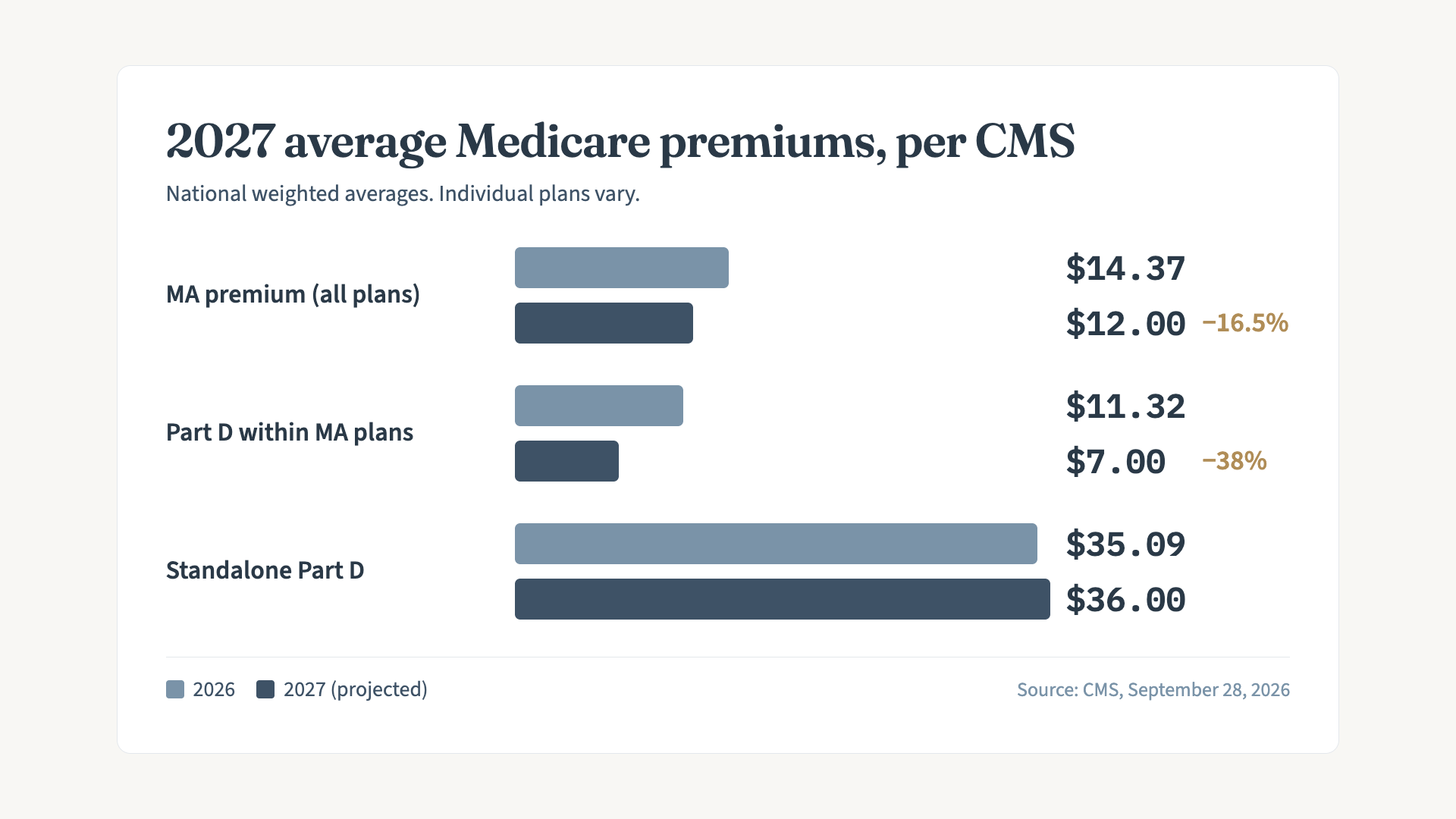
- CMS announced September 28 that the weighted average 2027 Medicare Advantage premium is projected to fall from $14.37 to $12.00 a month, a 16.5% decrease
- The average Part D premium built into Medicare Advantage plans, after rebates, is projected to fall from $11.32 to $7.00, a 38% decrease
- The standalone Part D premium, for people who buy drug coverage separately from Original Medicare, is projected to rise from $35.09 to $36.00, an increase of less than $1
- CMS projects about 5,532 Medicare Advantage plans will be offered nationally in 2027, close to 2026's 5,553, and says roughly 8 in 10 current MA members will be able to stay in their plan at the same or a lower premium
- These are national, enrollment-weighted averages. They describe the overall market, not any single plan
- Two and a half weeks earlier, brokers reviewing early 2027 filings told an analyst to expect broad benefit reductions, naming Humana and UnitedHealthcare as likely to cut the most
- A lower national average premium and a specific plan cutting specific benefits are not necessarily in conflict — the reasons why are below
- Your own Annual Notice of Change, due by September 30, is the only document that tells you what's actually true for your plan
What CMS actually announced
CMS released its 2027 projections on September 28, and the headline numbers are genuinely large. The weighted average Medicare Advantage premium, which includes plans with drug coverage and Special Needs Plans, is projected to fall from $14.37 a month in 2026 to $12.00 in 2027, a decrease of about 16.5%. For Medicare Advantage plans that bundle in drug coverage, the average Part D portion of the premium, after the rebates insurers apply, is projected to fall from $11.32 to $7.00, a decrease of about 38%.
CMS also addressed the standalone Part D market directly, where a temporary federal program that had been smoothing out premiums is ending. The agency projects the average standalone Part D premium will rise from $35.09 to $36.00, an increase of less than a dollar. CMS described this as evidence of "broad pricing stability" in the Part D market following the end of that program, a characterization that pushes back on some earlier analyst commentary, including a caution we cited in our own Social Security and Part B coverage, that the program's end would add upward pressure on premiums.
On access, CMS projects more than 99% of Medicare beneficiaries will have at least one Medicare Advantage plan available to them, with 97% having 10 or more choices, and the total number of plans offered nationally holding roughly steady at about 5,532, down only slightly from 5,553 in 2026. CMS Administrator Dr. Mehmet Oz framed the results as evidence the agency is "keeping premiums stable" while expanding access to lower-cost Part D options, saying 93% of beneficiaries who don't receive low-income subsidies will have access to an enhanced Part D plan for less than $6 a month.
Sources: CMS — Medicare Advantage and Medicare Prescription Drug Programs Expected to Remain Stable in 2027, our 2027 Medicare hub
CMS's numbers are enrollment-weighted averages across the entire country. That math can move for reasons that have nothing to do with your specific plan getting richer or cheaper. If millions of members shift into lower-premium plans, or new low-cost plans enter the market and pull in enrollment, the national average falls even if some existing plans raise premiums or cut benefits. CMS itself puts the reassuring number at "about 8 in 10" current MA members keeping their plan at the same or lower premium, which also means roughly 2 in 10 do not. The only way to know which group you're in is to read your own Annual Notice of Change, due by September 30, and compare it against what CMS reports for the market as a whole.
Why the broker reports and CMS's numbers can both be right
Two and a half weeks before this announcement, we covered a different signal entirely. Brokers who'd gotten early looks at 2027 plan filings told Leerink Partners analyst Whit Mayo, in reporting picked up by Axios on September 10, that 2027 was shaping up as "another year of broad-based industry benefit reductions," with Humana and UnitedHealthcare — the two largest Medicare Advantage insurers — likely to cut the most. A survey of 35 health plan leaders around the same time found nearly 70% expected their own 2027 benefit packages to be less generous than 2026's. We wrote about that reporting in Why Are 2027 Medicare Advantage Benefits Still Shrinking?, and in an earlier, more optimistic piece asked whether Medicare Advantage was stabilizing for 2027 at all.
CMS's September 28 release doesn't retract or disprove that earlier reporting, and it isn't really answering the same question. The broker commentary was about benefit design at specific insurers: dental coverage levels, specialist copays, and Part B premium "giveback" perks at Humana and UnitedHealthcare specifically. CMS's release is about the national average premium across all plans and all insurers combined. A national average can fall because competitively priced plans are gaining enrollment share, even while some individual, previously generous plans get less generous. Both things can be true in the same year, in the same market, without either report being wrong.
It's also worth noting CMS's own framing choice. The agency's release explicitly pushes back on what it calls "misleading reports" about the standalone Part D market, tied to the same subsidy program whose end had prompted caution from outside analysts including Avalere Health. That's the agency's characterization of its critics, not an independent assessment, and readers weighing the two accounts should treat both the brokers' early-filing commentary and CMS's official projections as credible within their own scope, rather than assuming one side has been proven wrong.
Sources: CMS press release, our coverage of the broker-sourced reporting
Related Medicare Updates
✅What This Means For You
If you're turning 65 this year: CMS's national numbers are a reasonable sign that 2027 is a competitive, well-stocked market to shop in, with 97% of beneficiaries having 10 or more plan choices. That's a market-level fact, not a reason to skip comparing specific plans on your own doctors, medications, and the benefits you'll actually use.
If you're already on Medicare Advantage, especially with Humana or UnitedHealthcare: Read your Annual Notice of Change closely this year regardless of what CMS's national numbers say. The specific things broker reporting flagged — dental benefit levels, specialist copays, and Part B giveback perks — are exactly what to check line by line, since a falling national average doesn't guarantee your plan moved the same direction.
If IRMAA affects you: CMS's premium projections here are plan premiums, separate from your IRMAA surcharge, which is based on income and paid on top of whatever your plan charges. A lower MA premium doesn't reduce your IRMAA bill.
If you're on Medicare Advantage and comparing plans this fall: Use CMS's own Medicare Plan Finder at Medicare.gov to compare actual 2027 premiums, drug costs, and benefits for plans in your area, rather than relying on either the national press release or broker-sourced commentary. Both are useful context; neither is a substitute for checking your specific options.
Explore Further
What's actually driving the Part D number
The most consequential figure in CMS's release, for the roughly 34 million people projected to be in Medicare Advantage next year, is the 38% drop in the average Part D premium bundled into those plans. Understanding why it's falling that much helps explain how it fits with the broker reporting.
Medicare Advantage plans that include drug coverage can apply rebates, drawn from the broader Part C payment they receive, to reduce or eliminate the separate Part D premium a member pays. CMS's release credits part of this shift to the agency "slashing handouts to big insurance companies" while steering more of the remaining payment toward keeping premiums low rather than funding supplemental extras. That's a real tradeoff, not a free improvement: money that funds a lower headline premium is money that isn't going toward a richer dental allowance or a larger Part B giveback, which is precisely the category of benefit the broker reporting said was getting cut.
Separately, the standalone Part D market — for the roughly 25 million people who buy drug coverage on its own rather than through a Medicare Advantage plan — is returning to normal pricing after a temporary federal demonstration program ends. CMS projects that transition adds less than a dollar to the average standalone premium, calling the outcome "broad pricing stability." Our 2027 Part D changes page covers the separately finalized deductible and out-of-pocket cap changes that apply regardless of which path you're on.
Source: CMS press release
What to actually do with two conflicting-sounding reports
The practical response to this isn't picking which report to believe. It's using both as reasons to check your own plan carefully rather than assuming either the good news or the cautious news applies to you specifically.
Start with your Annual Notice of Change, due by September 30. It is the one document that describes your actual plan, not a national average or an early broker read. Compare this year's premium, deductible, copays, and any Part B giveback against what you had in 2026, line by line.
If you're with Humana or UnitedHealthcare, give that review extra attention, since those were the two insurers named in the broker-sourced reporting. A national premium decrease doesn't mean every plan at every insurer moved the same direction.
Once CMS's full 2027 landscape file is public — the same release that produced these national averages also includes plan-level data — use Medicare.gov's Plan Finder to compare your actual options by ZIP code, entering your real medications and preferred doctors rather than relying on either the national premium average or any single insurer's plan changes.
If you want a second opinion on what you're reading in your ANOC, a State Health Insurance Assistance Program counselor can review it with you at no cost. We'll update this page if CMS revises these figures when the full plan-level landscape data is published.
Table 1 — CMS's 2027 national average premium projections
| Premium type | 2026 | 2027 (projected) | Change |
|---|---|---|---|
| Weighted average MA premium (all plans) | $14.37/mo | $12.00/mo | −16.5% |
| Average Part D premium within MA plans (post-rebate) | $11.32/mo | $7.00/mo | −38% |
| Standalone Part D premium | $35.09/mo | $36.00/mo | +$0.91 (<3%) |
| Total MA plans offered nationally | 5,553 | ~5,532 | roughly stable |
| MA enrollment (projected) | — | ~34 million (47.4% of Medicare) | — |
Table 2 — Two reports, two different questions
| Basis of comparison | CMS (Sept 28, 2026) | Broker-sourced reporting (Sept 10, 2026) |
|---|---|---|
| Source | CMS official press release | Leerink Partners analyst note, via Axios |
| What it measures | National, enrollment-weighted average premiums | Specific benefit design at specific insurers |
| Insurers named | None specifically | Humana, UnitedHealthcare named as cutting most |
| Headline finding | Premiums falling 16–38% on average | ~70% of surveyed plan leaders expect less generous benefits |
| Status | CMS-confirmed national figures | Broker commentary on early, preliminary filings |
Illustration only, not a recommendation. Sources: CMS; Axios/Leerink Partners reporting as cited in our September 10 coverage.
Answer six quick questions to see which Medicare path matches your health, budget, and timing — Find Your Medicare Path in 60 Seconds →