In this article5
Here's a number that doesn't fit the story you'd expect: for 2027, CMS didn't cut Medicare Advantage payment rates — it raised them, by 2.48%, worth roughly $13 billion industry-wide. That increase followed an intense industry lobbying push against a lower initial proposal, with insurers warning that anything less would put beneficiary care at risk. And yet, according to insurance brokers who've gotten early looks at 2027 plan filings, benefits are shrinking anyway — broadly, and especially at the two largest Medicare Advantage insurers in the country. Here's what's actually being reported, what's confirmed versus still preliminary, and what it means for your plan this fall.
📋Quick Summary
- CMS finalized a 2.48% Medicare Advantage payment increase for 2027 — about $13 billion industry-wide — well above its initial 0.9% proposal.
- Despite that increase, brokers who reviewed early 2027 plan filings report widespread benefit reductions, according to a Leerink Partners analyst note reported by Axios on September 10, 2026.
- UnitedHealthcare reportedly dropped about 13% of its plans across 18 states for 2027, but the company has not confirmed that broker-sourced figure.
- Humana confirmed it is exiting plans affecting approximately 600,000 members for 2027, its second consecutive year of cuts.
- Nearly 70% of 35 health plan leaders surveyed by HealthScape Advisors expect their 2027 benefit packages to be less generous than in 2026.
- Brokers report reductions in dental benefits, higher specialist copays, drug cost-sharing changes, and reduced or eliminated Part B premium givebacks.
- These are early signals from preliminary filings. Official plan details arrive with CMS's landscape release and are confirmed for shoppers when Annual Enrollment opens October 15.
The Number That Doesn't Add Up — and Why It Might
Understanding why this story is getting attention requires knowing what changed on the payment side first. Each year, CMS sets Medicare Advantage payment rates through an Advance Notice and a final Rate Announcement. For 2027, the initial proposal was a modest 0.9% increase. Insurers and industry groups responded with a sustained lobbying campaign, submitting extensive comments arguing that a rate that low would force cuts to beneficiary care. CMS's final number came in well above that initial figure: a confirmed 2.48% average increase, worth more than $13 billion in additional Medicare Advantage payments for 2027.
Given that outcome, many industry observers expected fewer benefit reductions than in 2026. That expectation is what makes the current reporting notable. Insurance brokers typically get an early look at the following year's plan designs before official plan information is released. Their preliminary view suggests another year of broad reductions rather than a rebound.
Leerink Partners analyst Whit Mayo, reviewing broker commentary on early filings, wrote that 2027 “sets up as another year of broad-based industry benefit reductions.” The September 10 Axios report said Mayo identified Humana and UnitedHealthcare as likely to cut the most. Both companies declined to comment to Axios on the note's specific figures. UnitedHealthcare CFO Wayne DeVeydt separately said the company expects to be “very competitive” on 2027 pricing while “right-sizing” products in some markets.
This directly follows our earlier explanation of the confirmed payment and marketing changes in Why Could Your 2027 Medicare Sales Call Come Faster Now?. See the broader calendar in What's Changing for Medicare in 2027.
Sources: Axios reporting from September 10, 2026, based on a Leerink Partners analyst note; related Forbes reporting on early 2027 plan changes.
Read this before you panic about a specific number. Two different kinds of information are circulating. Confirmed: CMS's 2.48% payment increase is finalized federal policy, and Humana confirmed on its July 29 earnings call that its exits affect about 600,000 members. Not yet confirmed: UnitedHealthcare's reported 13%-of-plans reduction across 18 states and the broader dental, copay, drug-cost and giveback reductions. Those come from broker commentary on preliminary filings relayed through an analyst note. UnitedHealthcare declined to confirm the specific figure. Official premiums, benefit levels and exact plan counts become public with CMS's full landscape release, expected in mid-to-late September, and are confirmed for shoppers when Annual Enrollment opens October 15.
The Specific Cuts Being Reported
Brokers have described several recurring patterns in the early plan designs. Dental benefit reductions appear repeatedly, especially benefits covering more than routine cleanings. That would continue the broader retreat from supplemental benefits that members have already seen. For context, see Why Did My 2026 Medicare Plan Cut My Benefits?.
Higher specialist copays are another recurring theme. Even where the basic plan structure stays familiar, the cost of seeing a cardiologist, orthopedist or rheumatologist may rise. Changes to prescription drug cost-sharing are also appearing alongside the separately finalized 2027 Part D changes, including a higher standard deductible and out-of-pocket cap. Those nationwide drug-program changes are explained in our 2027 Part D guide.
The most immediately visible change may be a reduced or eliminated Part B premium “giveback.” A giveback is when a Medicare Advantage plan pays part of a member's Part B premium, which can appear as a larger Social Security payment. If that benefit shrinks, your monthly income falls even when the plan's advertised premium does not change. That is why checking only the premium can miss the change that matters most to your budget.
Some insurers are also reportedly considering mid-year enrollment caps in specific counties. That is an early, broker-sourced signal rather than a confirmed action by a named plan. It could make the timing of comparison shopping more important, but no reader should assume a particular local plan will close enrollment until official information says so.
Sources: Forbes and Medical Daily reporting on preliminary 2027 plan filings and broker observations.
Related Medicare Updates
✅What This Means for You
If you're turning 65 this year: don't choose a Medicare Advantage plan solely for this year's extras, including a Part B giveback. Early reports suggest that benefit is among those most likely to shrink or disappear in 2027 filings.
If you're already on Medicare Advantage, especially with Humana or UnitedHealthcare: read your Annual Notice of Change closely. Check the giveback amount, specialist copays and dental limits rather than only the monthly premium.
If IRMAA affects you: these changes do not alter your IRMAA determination. But losing a Part B giveback raises your net monthly cost even while the official premium and income-related surcharge stay the same.
If earlier reporting made 2027 look more stable: that analysis reflected genuinely improving insurer finances. This newer broker-sourced reporting complicates the picture: better finances have not reliably translated into richer benefits. Read our earlier assessment, Is Medicare Advantage Finally Stabilizing for 2027?, and the company-confirmed Humana update, Is Your 2027 Humana Medicare Advantage Plan Being Cut?.
Explore Further
Why More Money Isn't Producing Richer Benefits
The apparent contradiction has several credible explanations, although no single explanation has been confirmed as definitive. The most direct is that medical costs may have outpaced the payment increase. Post-pandemic care use came in above prior forecasts, providers have resisted unfavorable contract terms, and federal scrutiny of Medicare Advantage payment practices has intensified. A 2.48% increase can be substantial in aggregate and still fall short of the cost growth an individual plan is trying to absorb.
Star Ratings add a second pressure. CMS tightened quality thresholds for 2027, with roughly half of the relevant cutpoints becoming harder to reach and much of that change concentrated in clinical-quality measures. UnitedHealthcare has been described as particularly exposed: applying prior performance to the tougher thresholds could lower the rating of its largest contract. A lower rating can reduce quality bonus payments and offset part or all of a base-rate increase for an affected plan.
A third view is structural. Some health economists argue Medicare Advantage has historically been paid more than equivalent care in Original Medicare, and that margin helped finance supplemental benefits. Under that view, a larger payment increase does not guarantee richer benefits if insurers are also repricing products to meet longer-term margin and risk targets.
Historical context also matters: approximately 10% of Medicare Advantage enrollees had their plan exit their market in 2026, according to a study cited in current reporting. That is a look backward, not a prediction for 2027. The practical lesson is narrower: a federal payment increase is not a reliable forecast of what your local plan will offer.
Source: The Modern Medicare Agency, “The Medicare Advantage Shakeup Heading Into 2027”; insurer and CMS reporting cited above.
| CMS 2027 Medicare Advantage payment increase — CONFIRMED | 2.48% average, about $13 billion industry-wide |
|---|---|
| Humana member impact — CONFIRMED BY COMPANY | about 600,000 members affected, second consecutive year of exits |
| UnitedHealthcare plan reduction — REPORTED, NOT COMPANY-CONFIRMED | about 13% of plans across 18 states |
| Health plan leaders expecting less generous 2027 benefits — SURVEY DATA | nearly 70% of 35 leaders surveyed by HealthScape Advisors |
| Medicare Advantage enrollees whose plan exited their market in 2026 — HISTORICAL CONTEXT | approximately 10% |
| Part B giveback trend — REPORTED | reduction or elimination at some insurers |
| CMS full 2027 landscape release — SCHEDULED | mid-to-late September 2026 |
| Annual Enrollment Period — SCHEDULED | October 15 through December 7, 2026 |
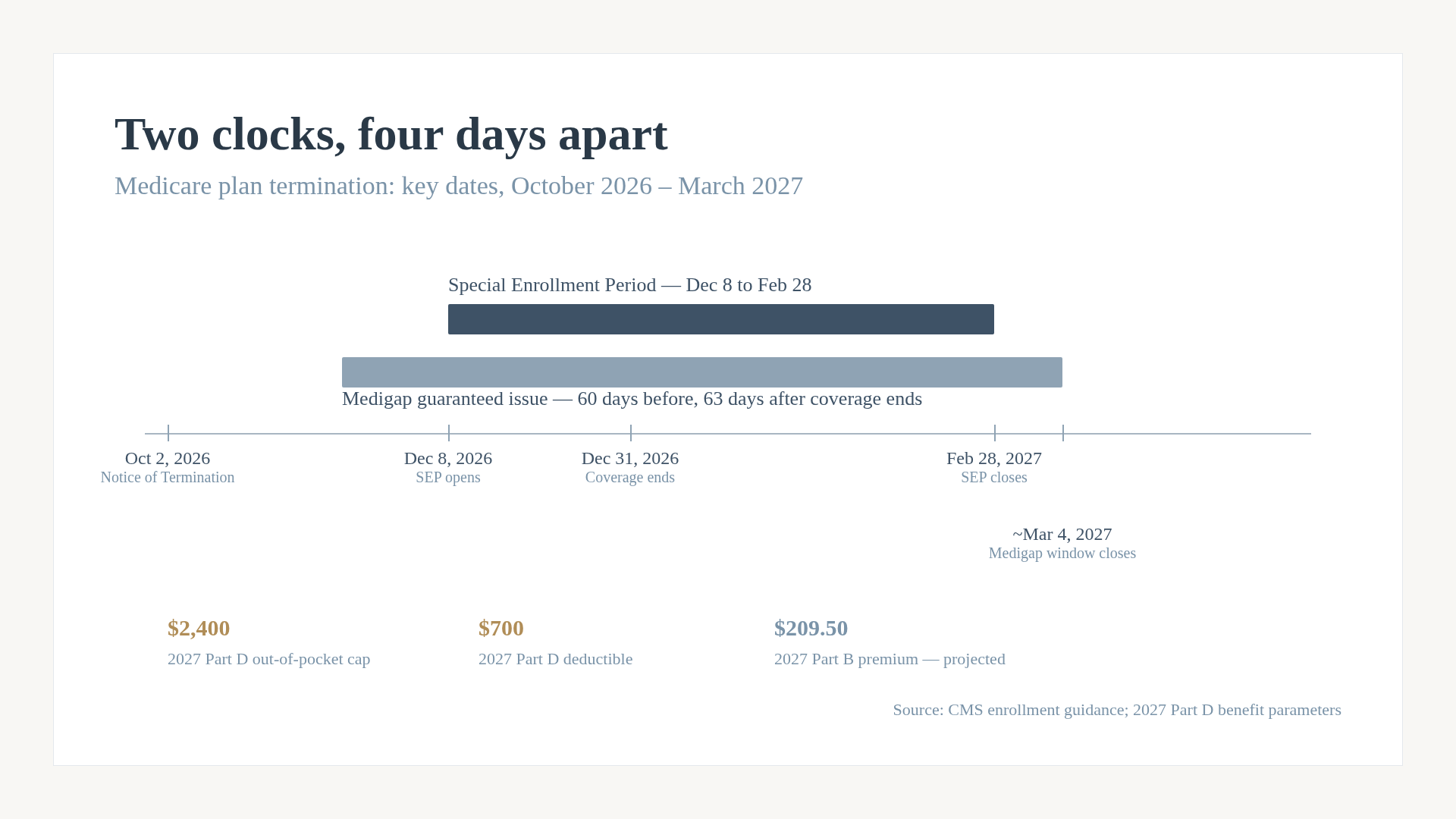
| Special Enrollment Period if a plan is non-renewed — RULE | December 8 through the last day of February |
| Sources — Axios; HealthScape Advisors; company statements; CMS policy and enrollment guidance | |
What to Actually Do This Fall
Wait for your Annual Notice of Change before assuming the worst. The current reporting describes an industry pattern, not a confirmed outcome for your specific plan. Your ANOC, required by September 30, is the authoritative document for your plan's actual 2027 changes. Our guide to why this September Medicare letter matters shows what to look for.
Read specifically for giveback benefits, specialist cost-sharing, dental limits and drug costs — not just the headline premium. If you're with Humana or UnitedHealthcare, allow extra time for that review because those companies are named in the current reporting. That does not mean every plan they offer will make the same changes.
If you find cuts you do not accept, begin comparing plans early in the October 15 to December 7 window. Do not treat a reported enrollment cap as a reason to rush into an unverified choice, but do not leave a careful review until the final days either. See Should You Switch Medicare Plans Before December 7?
Verify your doctors and hospitals with the specific plan, not merely the insurer. If you want a second opinion, a State Health Insurance Assistance Program counselor can review your ANOC and compare alternatives without selling you a policy. You can find a SHIP counselor for free Medicare help in your state.
Sources: CMS Annual Notice of Change and Annual Enrollment guidance; current broker-sourced reporting cited above.
Related 2027 Medicare Coverage
- What's Changing for Medicare in 2027
- 2027 Part D Changes
- Is Your 2027 Humana Medicare Advantage Plan Being Cut?
- Why Could Your 2027 Medicare Sales Call Come Faster Now?
- Is Medicare Advantage Finally Stabilizing for 2027?
- Why This September Medicare Letter Matters More Than Any Other
Not sure if your Medicare Advantage plan is one of the ones cutting benefits for 2027?
Not Sure Where You Fit?
Find Your Medicare Path in 60 Seconds
Answer 6 quick questions to see what applies to you — whether you're getting started, managing costs, or comparing plans.
Start the Quick Quiz