In this article4
Yesterday the Centers for Medicare and Medicaid Services finalized a new, mandatory pricing model for certain drugs covered under Medicare Part B — the physician-administered medications used for conditions like cancer, rheumatoid arthritis, and macular degeneration, not the pills you pick up at a pharmacy. The Global Benchmark for Efficient Drug Pricing, or GLOBE, Model ties certain Part B drug rebates to prices paid in other developed countries, starting in 2027. The headline sounds like straightforward good news. The fine print tells a more complicated story: the savings CMS now projects are a small fraction of what the agency projected when it first proposed this same model last December.
📋Quick Summary
- CMS finalized the mandatory GLOBE Model on September 30, affecting certain Medicare Part B drugs and biologics administered by clinicians, not retail pharmacy drugs
- The model runs 5 years, January 1, 2027 through March 31, 2032, with manufacturer rebate reconciliation continuing through March 31, 2034
- It applies only to randomly selected geographic areas covering about 25% of Original Medicare Part B beneficiaries — not everyone
- Affected beneficiaries may see reduced out-of-pocket costs starting April 1, 2027
- Targeted drug categories include oncology, rheumatology, immunology, ophthalmology, and endocrinology medications
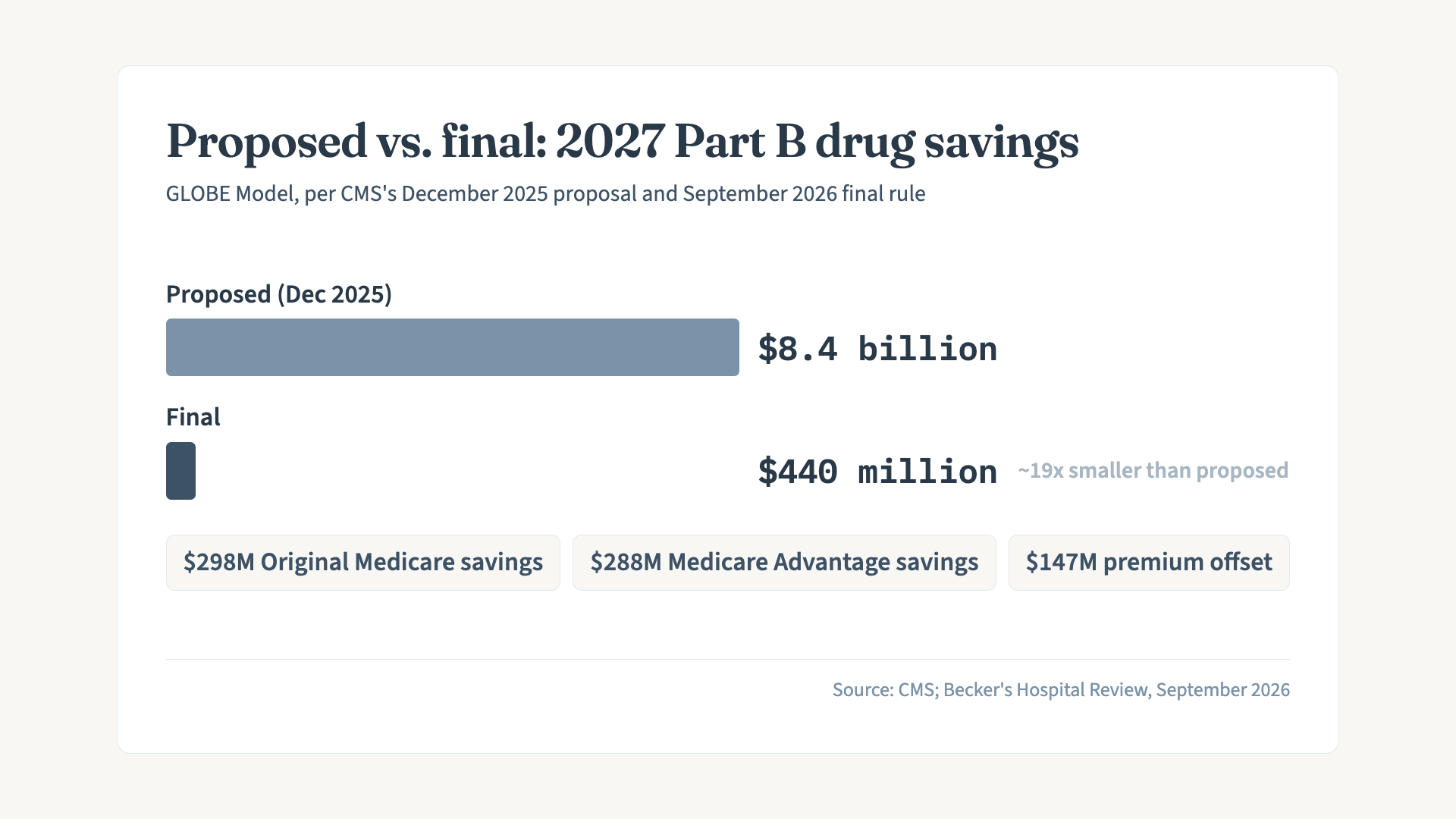
- The proposed version of this rule, in December 2025, projected $8.4 billion in Part B savings. The final rule projects $440 million — about 19 times smaller
- CMS added new exclusions in response to public comments: biosimilars, orphan-only drugs, plasma-derived products, and certain cell and gene therapies are now carved out, which is part of why the savings estimate shrank
- This is a different, newer program than the 2020 Most Favored Nation Model and unrelated to the IRA's negotiated-price drug list or the Medicare GLP-1 Bridge
What GLOBE actually does
The Global Benchmark for Efficient Drug Pricing Model targets a specific, often-overlooked category of Medicare spending: drugs and biologics that are administered by a clinician in a medical setting rather than picked up at a pharmacy counter. Think chemotherapy infusions, injectable treatments for rheumatoid arthritis, eye injections for macular degeneration, and similar Part B-covered biologics. CMS has pointed to real pressure in this category: according to HHS's Office of the Assistant Secretary for Planning and Evaluation, cited in CMS's own announcement, Original Medicare Part B drug spending grew nearly four times as fast as drug spending across all payers combined between 2008 and 2021.
The model works by changing how Medicare calculates the inflation rebate manufacturers owe when they raise prices faster than inflation on certain Part B drugs. Instead of using the current formula alone, GLOBE will test an alternative benchmark drawn from prices paid in other economically comparable countries. Dr. Oz said Medicare Part B patients and taxpayers have long paid more for these drugs than people in comparable countries.
Importantly, GLOBE won't touch every Part B drug, and it won't touch every beneficiary. CMS excluded biosimilars and the brand-name biologics they compete with once a biosimilar is on the market, along with orphan-only drugs, plasma-derived products, and certain cell and gene therapies — carve-outs the agency added specifically in response to public comments on the original proposal. And geographically, the model only applies to beneficiaries in a randomly selected set of ZIP code areas, covering roughly a quarter of people with Original Medicare Part B as their primary coverage. If you're not in one of those areas, this model doesn't apply to your Part B drug costs at all, regardless of what drugs you take.
CMS first proposed this exact model in December 2025, projecting it would save Original Medicare Part B about $8.4 billion over its run, with billions more in additional savings for Medicare Advantage and Medicaid. The final rule, announced yesterday, projects total Part B net spending savings of just $440 million over the model's full payment period — roughly 19 times smaller than the original estimate. That total breaks down to $298 million in Original Medicare Part B benefit savings and $288 million in Medicare Advantage payment savings, offset by $147 million in premium impacts. Some of that gap comes directly from the new exclusions CMS added after public comment — biosimilars, orphan drugs, plasma products, and cell and gene therapies are now out of scope, which removes a meaningful chunk of drug spending from the model entirely. Whatever the reason, the realistic savings this program delivers are a small fraction of what was advertised when it was proposed.
Source: Becker's Hospital Review, "CMS finalizes new drug pricing model: 7 notes," September 30, 2026
Who's actually affected, and when
Two filters determine whether GLOBE touches your Part B costs at all: where you live, and what drug you take.
Geography comes first. CMS selected a random subset of ZIP Code Tabulation Areas for the model, covering about 25% of Original Medicare beneficiaries nationally. There's no way to know in advance from this article whether your specific ZIP code is included — that detail is expected to be published alongside the model's implementation materials at CMS's GLOBE Model page as 2027 approaches. If you're not in a selected area, none of this changes what you pay for Part B drugs, regardless of what you're prescribed.
Drug category comes second. Even within a selected area, GLOBE only applies to certain separately payable Part B drugs and biologics — broadly, medications in categories like oncology, rheumatology, immunology, ophthalmology, and endocrinology, administered by a clinician rather than filled at a pharmacy, per a same-day industry roundup. Routine prescription drugs you pick up at a pharmacy, covered under Part D, are entirely unaffected by this model.
For beneficiaries who do fall into a selected area with a covered medication, CMS says reduced out-of-pocket costs could begin showing up as early as April 1, 2027 — three months after the model itself starts on January 1, 2027. The model's core operating period runs through March 31, 2032, a five-year span, though manufacturer rebate invoicing and reconciliation continues for two additional years beyond that, through March 31, 2034. Both the five-year and seven-year figures you may see reported elsewhere are accurate; they're describing different parts of the same timeline, not conflicting claims.
Related Medicare Updates
✅What This Means For You
If you're turning 65 this year: This model doesn't affect your plan choice or enrollment decisions. It's a payment-calculation change behind the scenes for certain Part B drugs, and whether it ever touches your costs depends entirely on where you live and what you're prescribed, starting in 2027.
If you're already on Medicare and take a clinician-administered Part B drug: Categories like oncology infusions, rheumatology biologics, and ophthalmology injections are among those targeted. Whether you'll actually see a difference depends on your ZIP code being selected, which CMS has not yet published in a beneficiary-searchable form as of this announcement.
If IRMAA affects you: This model doesn't change your IRMAA surcharge, which is based on income. The $147 million in premium impacts CMS mentions in its final estimate reflects the program's effect on standard Part B premium calculations across the whole risk pool, not anything specific to IRMAA brackets.
If you're on Medicare Advantage: The final estimate includes $288 million in projected Medicare Advantage payment savings over the model's run, separate from the Original Medicare Part B savings. Your plan's actual premium or benefit design isn't something this model changes directly — it affects how much Medicare pays out system-wide, which is a different thing from what shows up on your specific plan's bill.
Explore Further
Why the savings estimate collapsed
The gap between $8.4 billion proposed and $440 million final is large enough to deserve its own explanation, and the answer is mostly about scope.
When CMS proposed GLOBE in December 2025, the rule as written would have applied more broadly. Public comments raised concerns about specific drug categories where the new international-benchmark rebate formula could create problems — orphan drugs developed for small patient populations where there's limited ability to raise prices without undermining the business case for developing them in the first place, biosimilars still establishing themselves against entrenched reference biologics, plasma-derived products with their own distinct manufacturing economics, and cell and gene therapies representing some of medicine's newest and most complex treatments. CMS's final rule carved all of these out.
Each exclusion removes real drug spending from the model's reach, and together they appear to account for a substantial share of the gap between the original $8.4 billion projection and the final $440 million figure. That's a defensible outcome from a policy standpoint — the comment process exists specifically to catch unintended consequences before a mandatory rule takes effect — but it also means the version of this program that actually launches in 2027 is a considerably smaller intervention than the one originally announced.
There's a broader pattern worth naming plainly: proposed federal rules routinely scale back between initial proposal and final publication, as public comment periods surface real-world complications. We've tracked a similar dynamic in 2027 Medicare Advantage payment policy, where an initially modest payment proposal ended up finalized at a higher number after industry pushback — the opposite direction from GLOBE, but the same underlying lesson: a proposed rule's headline numbers are a starting point for negotiation, not a reliable preview of the final outcome.
What to actually watch for between now and 2027
Nothing about this model requires you to do anything right now, but a few concrete things are worth tracking as 2027 approaches.
Watch for CMS to publish which specific ZIP code areas are included in the model. That information is expected on CMS's GLOBE Model page as implementation details firm up. Once it's public, you'll be able to check whether your own area is affected directly, rather than relying on national averages or projections.
If you take a clinician-administered Part B drug in one of the targeted categories — oncology, rheumatology, immunology, ophthalmology, or endocrinology — ask your provider's billing office whether they're aware of GLOBE Model participation as 2027 approaches. Practices that bill Medicare for these drugs will likely have earlier visibility into implementation details than individual patients will.
Treat any "your drug costs will drop dramatically" messaging around this program with appropriate skepticism. The realistic savings CMS itself now projects, $440 million against an original $8.4 billion estimate, are modest relative to overall Part B drug spending, concentrated in specific places and specific drug categories, and not something every Medicare beneficiary will experience.
If you want to track this alongside everything else changing in 2027, our 2027 Medicare hub is where we're keeping the full picture in one place, including what's happening with Medicare Advantage premiums and plan availability and how Part B premiums compare to your Social Security raise next year.
Source: CMS GLOBE Model page
Table 1 — GLOBE Model: proposed vs. final
| Item | Proposed (Dec 2025) | Final |
|---|---|---|
| Projected Part B net savings | $8.4 billion | $440 million |
| Reduction from proposal | — | ~19x smaller |
| Original Medicare Part B benefit savings | included in above | $298 million |
| Medicare Advantage payment savings | included in above | $288 million |
| Premium impact offset | not specified | $147 million |
| Key new exclusions | none | biosimilars, orphan drugs, plasma products, cell/gene therapies |
Table 2 — GLOBE Model timeline
| Date | What happens |
|---|---|
| December 2025 | GLOBE Model proposed |
| September 30, 2026 | GLOBE Model finalized |
| January 1, 2027 | Model begins operating |
| April 1, 2027 | Affected beneficiaries may see reduced costs |
| March 31, 2032 | 5-year model operating period ends |
| March 31, 2034 | Manufacturer rebate reconciliation ends (7-year financial tail) |
Sources: CMS press release; Becker's Hospital Review
Answer six quick questions to see which Medicare path matches your health, budget, and timing — Find Your Medicare Path in 60 Seconds →