In this article12
- 01What Is IRMAA? A Quick Refresher
- 02Selling Gold, Stock, or Property: The Trigger Nobody Plans For
- 03The Two-Year Time Bomb
- 04Hidden Trigger #1: The Roth Conversion Trap
- 05Hidden Trigger #2: Capital Gains from Investment Sales
- 06Hidden Trigger #3: Real Estate Sales and Property Transactions
- 07Hidden Trigger #4: Required Minimum Distributions (RMDs)
- 08Hidden Trigger #5: Part-Time Work and Side Income
- 09When You Can Appeal: The SSA-44 Form
- 10Strategies to Stay Below IRMAA Thresholds
- 11Frequently Asked Questions
- 12Related Articles
You've spent decades planning for retirement. You've calculated your Social Security benefits, estimated your pension income, and maybe even mapped out a conservative withdrawal strategy from your 401(k). You think you have a clear picture of your financial future.
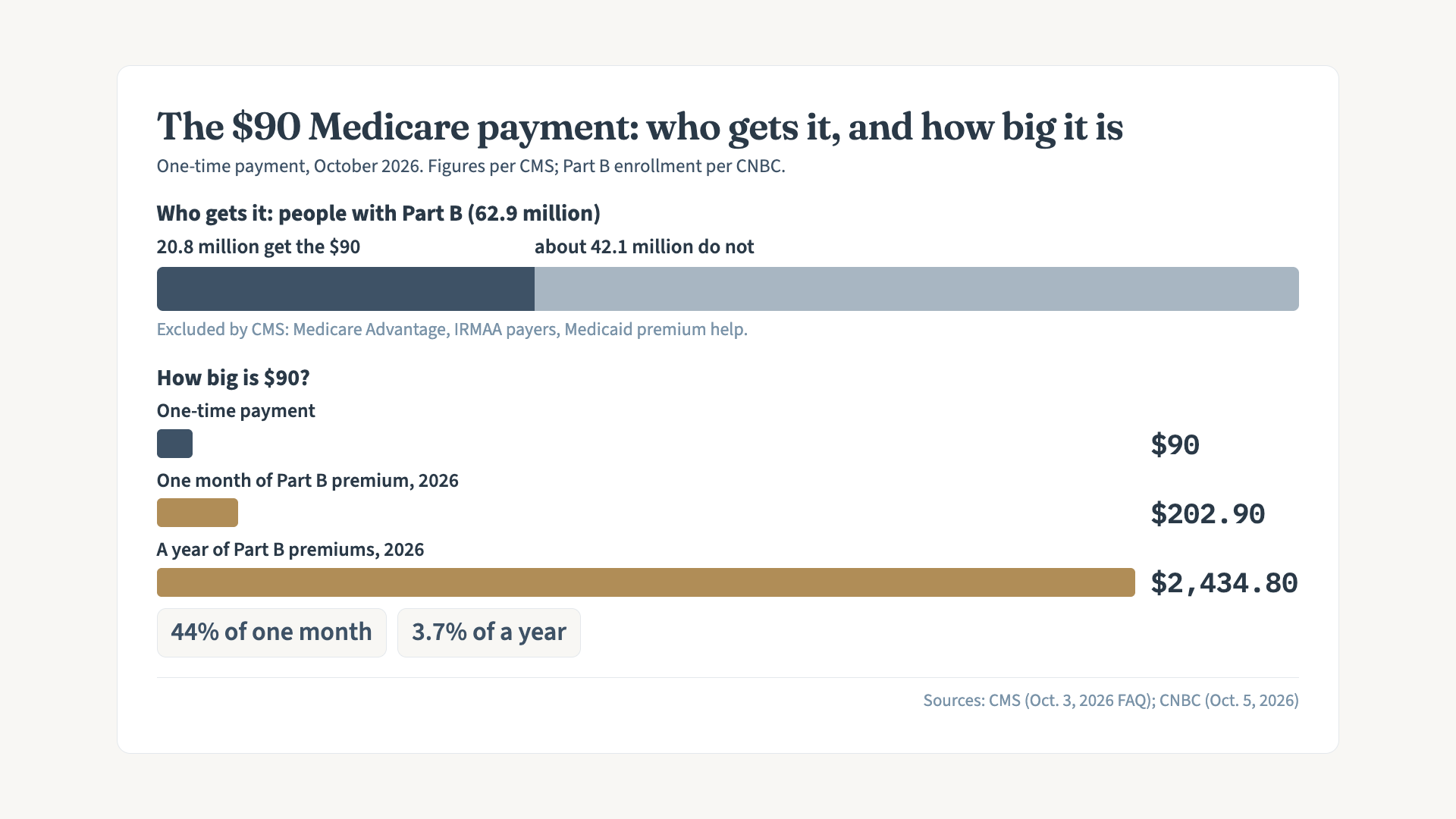
Then you receive a letter from Social Security, and suddenly your Medicare Part B premium has jumped from the standard $202.90 to nearly $690 per month. Welcome to the world of IRMAA—the Income-Related Monthly Adjustment Amount that catches thousands of retirees off guard every single year.
As someone who has guided countless retirees through Medicare planning, I can tell you that IRMAA is one of the most misunderstood aspects of healthcare costs in retirement. The confusion isn't your fault. IRMAA operates on a two-year lookback system, uses income brackets that don't align with tax brackets, and can be triggered by financial events that seem completely reasonable—or even necessary—during your retirement years.
Let me walk you through the hidden triggers that cause IRMAA to surprise retirees, and more importantly, how you can plan ahead to minimize or avoid these surcharges altogether.
Key Takeaway
IRMAA is based on your income from two years ago, not your current income. Every major financial decision you make today—from Roth conversions to stock sales—can affect your Medicare premiums two years later.
What Is IRMAA? A Quick Refresher
Before we dive into the surprises, let's make sure we're all on the same page about what IRMAA actually is.
IRMAA is an additional premium charge that higher-income Medicare beneficiaries pay on top of their standard Medicare Part B and Part D premiums. It's based on your Modified Adjusted Gross Income (MAGI) from two years prior. So if you're paying Medicare premiums in 2026, Social Security is looking at your 2024 tax return to determine whether you owe IRMAA surcharges.
The income brackets create a tiered system. As your MAGI rises above certain thresholds, your premiums increase accordingly. For 2026, these brackets start at $109,000 for individuals and $218,000 for married couples filing jointly. View the complete 2026 IRMAA brackets and surcharge amounts.
Here's the critical point most retirees miss: IRMAA isn't based on your current income. It's based on what you earned two years ago, which might have been before you retired or during a year when you had unusual income events.
Selling Gold, Stock, or Property: The Trigger Nobody Plans For
Related Medicare Updates
The single most common misunderstanding we hear about asset sales is that the whole check counts. It does not. Only the taxable gain enters your MAGI, and your cost basis comes out first. If you paid $40,000 for gold coins years ago and sold them for $95,000, the figure Social Security eventually sees is the $55,000 gain, not the $95,000 that landed in your bank account. That distinction is often the difference between staying under a threshold and crossing one, which is why it is worth calculating the gain precisely before you sell rather than after the sale is done.
The timing matters just as much as the arithmetic. Your 2026 premiums are set from your 2024 federal return, so a sale you made two years ago is what governs the bill arriving now. And MAGI is not simply your adjusted gross income — it is your AGI plus any tax-exempt interest. Municipal bond interest counts here even though you never paid federal tax on it, which surprises retirees who deliberately built a tax-free income stream and assumed it would stay invisible to Medicare.
Collectibles carry an additional wrinkle. Gold coins and bullion are treated as collectibles by the IRS, and long-term gains on collectibles can face a federal rate as high as 28% — above the maximum that applies to ordinary long-term capital gains. So a precious-metals sale can be taxed more heavily than a stock sale of the same size and still push the same amount of gain into your MAGI for IRMAA purposes.
Real estate is handled differently again. A primary-residence sale gets the IRS exclusion applied first: up to $250,000 of gain for a single filer and up to $500,000 for a married couple filing jointly. Only gain above that exclusion lands in your MAGI. Land, second homes, and vacation property receive no exclusion at all, so the entire gain flows through — which is why the sale of a modest lakeside cabin can do more damage to a Medicare premium than the sale of a far more valuable primary home.
The survivor trap deserves its own warning. IRMAA thresholds for a single filer are exactly half the married-filing-jointly thresholds. A surviving spouse who sells an asset files as a single taxpayer against those halved brackets, and the same sale that would have been comfortably absorbed while both spouses were alive can land two tiers higher. Household expenses did not fall by half when the spouse died, but the income thresholds did — and this is the scenario we see produce the most distressing surcharge letters.
| Married filing jointly — standard premium up to | $218,000 |
|---|---|
| Single filer — standard premium up to | $109,000 |
| MFJ first surcharge tier begins | $218,001 |
| Single first surcharge tier begins | $109,001 |
| Income year used for 2026 premiums | 2024 tax return |
The Two-Year Time Bomb
The two-year lookback is where much of the confusion begins. Picture this common scenario:
Sarah retired in June 2024 after a successful career as a hospital administrator. Her salary that year was $145,000 for those six months. She also received a retirement bonus of $25,000 and cashed out her unused vacation time for another $8,000. Her total 2024 income: $178,000.
Fast forward to 2026. Sarah is now living comfortably on $55,000 per year from Social Security and a small pension—well below any IRMAA threshold. But when she receives her Medicare premium notice, she's shocked to find she's being charged IRMAA surcharges based on that $178,000 income from 2024.
This scenario plays out thousands of times every year. Retirees assume that because their current income is modest, their Medicare premiums will be standard. They forget—or never realized—that Medicare is looking backward, not forward.
Hidden Trigger #1: The Roth Conversion Trap
Roth conversions are a popular and often smart retirement planning strategy. You convert traditional IRA funds to a Roth IRA, pay taxes on the conversion now, and enjoy tax-free growth and withdrawals later. Financial advisors frequently recommend these conversions during the early retirement years when you might be in a lower tax bracket but before Required Minimum Distributions (RMDs) begin.
Here's the trap: Roth conversions count as taxable income in the year you make them, which means they increase your MAGI and can trigger or increase IRMAA surcharges two years later.
Let me show you how this works with real numbers:
Robert and Linda are both 64 and recently retired. Their combined income from pensions and Social Security is $180,000—just under the married filing jointly IRMAA threshold of $218,000. Their financial advisor suggests converting $50,000 from Robert's traditional IRA to a Roth IRA to reduce future RMDs and tax liability.
It's good advice from a tax planning perspective. But that conversion pushes their 2024 MAGI to $230,000. Two years later, in 2026, they'll each pay an additional $2,048.40 annually in IRMAA surcharges—a total extra cost of $4,096.80 for the year.
The lesson here isn't to avoid Roth conversions—they can still make financial sense. The lesson is to do the math and consider the IRMAA impact when timing and sizing these conversions. Sometimes spreading a large conversion across multiple years, or doing smaller conversions that keep you just below an IRMAA threshold, makes more sense than one large conversion.
Hidden Trigger #2: Capital Gains from Investment Sales
Capital gains are another frequent culprit behind unexpected IRMAA charges. Whether you're rebalancing your portfolio, selling stocks to fund a major purchase, or liquidating investments as part of your retirement income strategy, those gains increase your MAGI.
Here's a scenario I see frequently:
Margaret, a widow, lives on $85,000 per year from Social Security and pension income. In 2024, she decided to downsize her investment portfolio and sold stocks she'd held for twenty years, realizing a $60,000 capital gain. Her total 2024 MAGI: $145,000.
In 2026, Margaret receives a notice that her Medicare Part B premium has increased from the standard amount to $333.30 per month—an additional $1,777.20 annually. She's confused because her current year income is still just $85,000.
The capital gains from 2024 pushed her into the second IRMAA bracket. If Margaret had known about the two-year lookback, she might have spread that stock sale across two or three years, keeping her below the first IRMAA threshold of $109,000 for individuals.
Hidden Trigger #3: Real Estate Sales and Property Transactions
Selling property—whether it's a vacation home, rental property, or even your primary residence in some cases—can generate substantial capital gains that trigger IRMAA surcharges.
Most people know about the primary residence capital gains exclusion ($250,000 for individuals, $500,000 for married couples). What they don't always realize is that gains above these exclusions count toward MAGI, and any gain from selling a second home, rental property, or investment property counts entirely.
Consider James and Patricia, who sold their beach condo in 2024 for a $180,000 profit after owning it for fifteen years. Combined with their regular retirement income of $190,000, their MAGI jumped to $370,000 for that year.
Two years later, they're facing the second-highest IRMAA bracket, with combined Medicare premiums of over $14,000 for the year—money they hadn't budgeted for since their current retirement income doesn't come close to that 2024 figure.
Real estate transactions often involve unavoidable timing, but understanding the IRMAA implications helps you prepare financially. Some retirees choose to complete property sales in years when they have life-changing events that might qualify them for an IRMAA appeal (more on that shortly).
Hidden Trigger #4: Required Minimum Distributions (RMDs)
RMDs begin at age 73 (for those born in 1951 or later) and force you to withdraw a percentage of your tax-deferred retirement accounts each year. These withdrawals are fully taxable and count toward your MAGI.
For many retirees, RMDs push them over IRMAA thresholds for the first time, and the problem compounds each year as RMD percentages increase with age.
Here's where advance planning makes a huge difference. Some strategies to consider:
Qualified Charitable Distributions (QCDs): If you're 70½ or older, you can donate up to $105,000 (in 2024) directly from your IRA to qualified charities. These distributions count toward your RMD but don't increase your MAGI—helping you satisfy the RMD requirement without triggering IRMAA.
Early distributions before RMDs begin: Taking strategic withdrawals from traditional IRAs in your 60s and early 70s (before RMDs kick in) can reduce your account balance and therefore reduce future RMDs. Yes, you'll pay taxes on these withdrawals, but you might stay below IRMAA thresholds during your peak Medicare years.
Roth conversions (done strategically): As mentioned earlier, Roth conversions will trigger IRMAA in the two-year lookback period, but they permanently reduce your traditional IRA balance and eliminate that money from future RMD calculations. Learn more about planning for Medicare changes in 2026.
Hidden Trigger #5: Part-Time Work and Side Income
Many retirees return to work part-time, whether for financial reasons, to stay active, or because they're not ready to fully retire. Consulting work, freelance projects, or even that retirement job at the local hardware store all generate income that counts toward MAGI.
The surprise comes when that modest part-time income, combined with Social Security, pension, and investment income, pushes you over an IRMAA threshold.
David retired at 65 but took on consulting work that paid $45,000 in 2024. Combined with his $72,000 in Social Security and pension income, his total MAGI was $117,000—just over the first IRMAA threshold of $109,000.
Two years later, he's paying an extra $889.20 annually in IRMAA surcharges. If David had throttled back his consulting to keep his 2024 income below $109,000, he would have avoided IRMAA entirely while only giving up about $8,000 in consulting income—a favorable tradeoff when you factor in the IRMAA costs and additional taxes.
When You Can Appeal: The SSA-44 Form
Not all IRMAA determinations are set in stone. Social Security allows appeals for certain "life-changing events" that have reduced your income since the two-year lookback period.
Qualifying life-changing events include:
- Marriage
- Divorce or annulment
- Death of a spouse
- Work stoppage or reduction
- Loss of income-producing property (not the sale—actual loss due to disaster, theft, etc.)
- Loss of pension income
- Employer settlement payment received due to closure or bankruptcy
If you've experienced one of these events and your income has dropped significantly, you can file form SSA-44 (Medicare Income-Related Monthly Adjustment Amount – Life Changing Event) to request that Social Security use a more recent year's income for your IRMAA determination.
Here's what's important to understand: You cannot appeal IRMAA simply because your income has dropped due to retirement if that retirement was planned and voluntary. The work stoppage exception typically applies to involuntary job loss, such as layoffs or mandatory retirement, not voluntary retirement.
However, if you retired in 2024 and are facing IRMAA in 2026 based on your 2024 income that included several months of full salary, you may have grounds for an appeal if you can demonstrate that your work stoppage was involuntary or that you've experienced another qualifying event.
The SSA-44 form requires documentation, such as tax returns showing your reduced income or proof of the life-changing event. The process can take several weeks, but successful appeals can save thousands of dollars annually.
Strategies to Stay Below IRMAA Thresholds
Now that you understand how IRMAA can surprise you, let's talk about proactive strategies to minimize or avoid these surcharges:
Time Your Income Events Strategically
If you're planning a Roth conversion, large stock sale, or property sale, consider the timing carefully. Can you spread the transaction across multiple tax years? Can you complete it in a year when you've already crossed an IRMAA threshold (so additional income won't push you into a higher bracket)?
Monitor Your Income Brackets
Know where you stand relative to IRMAA thresholds. If you're close to a bracket limit, be extra cautious about year-end decisions that might push you over. Sometimes deferring income by just a few weeks into the next year can save thousands in IRMAA surcharges two years later.
Consider Tax-Loss Harvesting
If you're facing a high-income year due to capital gains or other factors, tax-loss harvesting (selling investments at a loss to offset gains) can help reduce your MAGI and potentially keep you below IRMAA thresholds.
Use Qualified Charitable Distributions
If you're charitably inclined and meet the age requirements, QCDs are one of the most powerful tools for managing IRMAA while satisfying RMDs.
Plan for the Three-Year IRMAA Window
Remember, you'll face IRMAA for at least three years following any high-income event—the year of the event itself (when you're in the two-year lookback window) plus the two subsequent years. Factor this extended cost into your decision-making.
Planning for next year? See what's changing for Medicare in 2027.
✅What This Means for You
IRMAA surcharges represent one of the less visible but potentially significant costs of retirement. Understanding how the two-year lookback works and identifying the hidden triggers can help you avoid unpleasant surprises and make more informed financial decisions. Use our IRMAA Calculator to estimate your 2026 bracket.
The most important principle: Think two years ahead. Every financial decision you make today has Medicare premium implications two years down the road. Before executing any major financial transaction—Roth conversions, investment sales, property sales, or taking on additional income—run the numbers to see how it will affect your IRMAA status.
And remember, while avoiding IRMAA is a worthy goal, it shouldn't override sound financial planning. Sometimes paying IRMAA for a year or two is worth it if the underlying financial decision (like a strategic Roth conversion) provides greater long-term benefits. The key is making these decisions with your eyes wide open, understanding both the immediate benefits and the Medicare premium implications. See the latest Medicare news and updates here.
Explore Further
Frequently Asked Questions
Share This Article
Help other retirees avoid IRMAA surprises by sharing this guide:
Disclaimer: The information in this article is current as of November 2025 and is intended for educational purposes. Medicare rules and income thresholds are subject to change. Consult with a qualified financial advisor or Medicare counselor for personalized guidance on your specific situation.
Related Articles
You Might Also Like
Medicare 2026 IRMAA Guide: Brackets, Surcharges & Planning Strategies
Complete guide to 2026 IRMAA brackets and how to plan ahead
Read: Medicare 2026 IRMAA Guide: Brackets, Surcharges & Planning StrategiesMedicare 2026: What's Ahead for Premiums, Plan Choices & New Caps
Comprehensive overview of Medicare changes for 2026
Read: Medicare 2026: What's Ahead for Premiums, Plan Choices & New CapsMedicare Physician Fee Cuts & Telehealth Future in 2026
How 2026 policy changes affect your access to care
Read: Medicare Physician Fee Cuts & Telehealth Future in 2026How to Appeal an IRMAA Determination with Form SSA-44
Qualifying life-changing events, documentation, and the appeal timeline
Read: How to Appeal an IRMAA Determination with Form SSA-44Why Is My 2026 Medicare Premium Higher?
The reasons your Part B premium increased this year
Read: Why Is My 2026 Medicare Premium Higher?Surprise IRMAA Surcharges Catching Retirees Off Guard in 2026
How the two-year lookback produces unexpected surcharge letters
Read: Surprise IRMAA Surcharges Catching Retirees Off Guard in 2026