In this article4
📋Quick Summary
- IRMAA is a Medicare surcharge for higher-income beneficiaries — but "higher income" is based on your tax return from two years ago, not today
- In 2026, IRMAA kicks in for individuals earning over $109,000 in 2024, or couples earning over $218,000
- The surcharge works like a cliff — even $1 over a threshold triggers the full, higher charge for that entire bracket
- Common triggers include home sales, Roth conversions, IRA withdrawals, and required minimum distributions
- About 5 million Medicare beneficiaries are currently paying IRMAA — many for the first time
- If your income has dropped due to retirement, a spouse's death, or another life event, you can appeal
The Letter Nobody Expects
There is a particular kind of financial shock that doesn't come from a crisis. It comes from a quiet letter in an ordinary envelope. For millions of Medicare beneficiaries, that letter arrived before the start of 2026, carrying news that their monthly premium — the number they'd budgeted around, the number they'd assumed was settled — had been recalculated upward. Sometimes significantly upward.
The charge is called IRMAA: the Income-Related Monthly Adjustment Amount. It's a surcharge added on top of the standard Part B and Part D premiums for beneficiaries whose income crosses certain thresholds. Roughly 5 million Medicare enrollees pay it. And every year, a portion of them encounter it for the first time, without ever having heard the word before.
What makes IRMAA so persistently disorienting is the timing. The income Medicare uses to set your 2026 premium isn't your income right now. It's your Modified Adjusted Gross Income from your 2024 tax return — filed in 2025. The Social Security Administration looks back two years because that's the most recent IRS data available when premiums are calculated. A financial decision you made in 2024, reasonable at the time and often on the advice of a professional, can resurface as a surprise bill two years later with no warning and no obvious connection to what you're earning today.
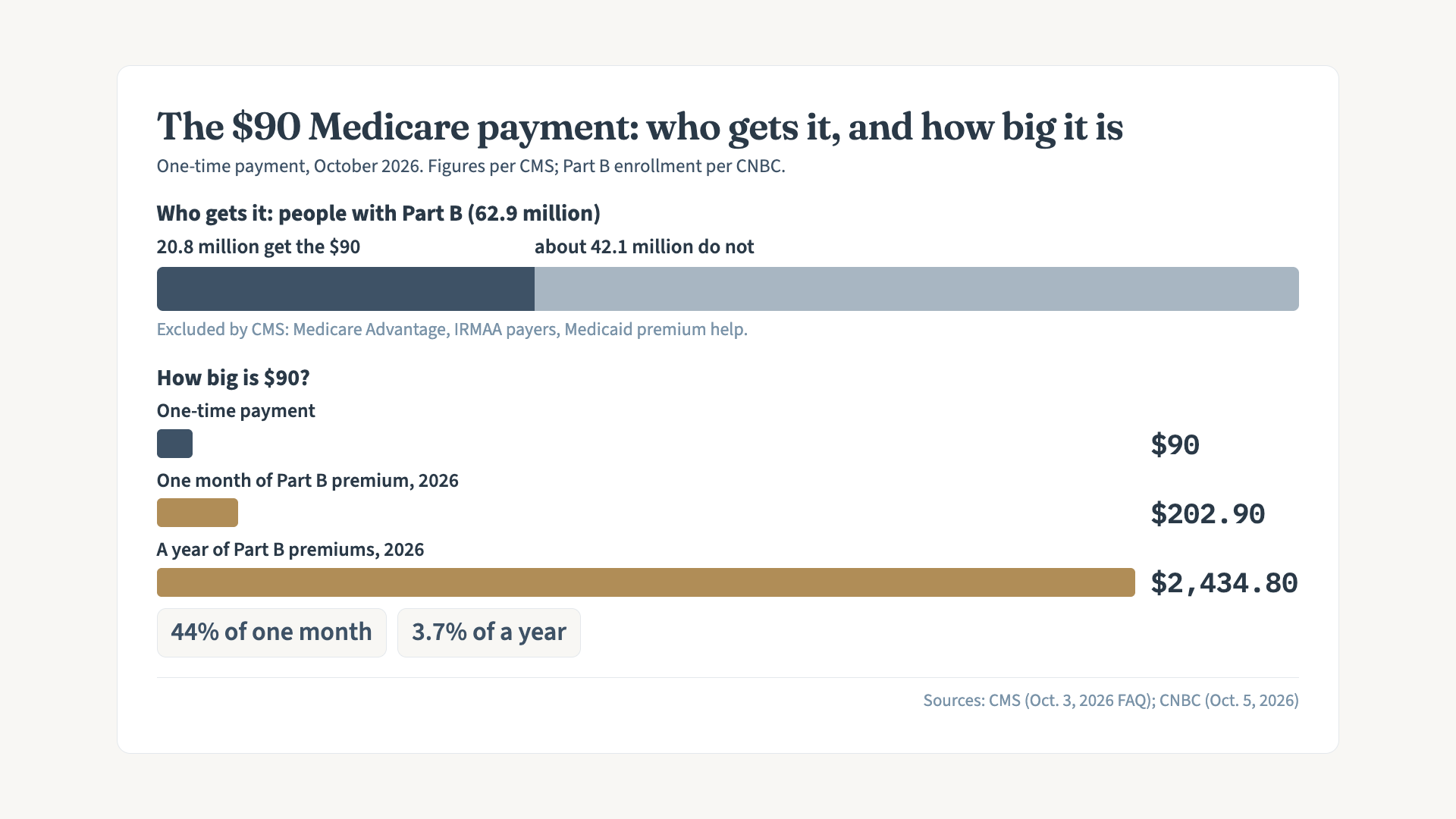
IRMAA doesn't work like income tax, where higher income is taxed gradually. It works like a cliff. If your 2024 MAGI was $109,000 as a single filer — exactly at the threshold — you pay the standard $202.90/month. If it was $109,001, you owe $284.10/month.
That single extra dollar costs an individual roughly $974 more per year. For a married couple where both spouses are on Medicare, crossing that same threshold by a dollar costs nearly $1,948 more annually. The cliff doesn't care why your income was high, or whether it's high anymore. It only sees the number on the return.
The Decisions That Trigger It — And Why Nobody Said Anything
The people who end up with IRMAA bills are often not the people you'd expect. They're not high earners with ongoing large salaries. They're retirees who made a one-time financial move — a perfectly sensible one — and had no idea it would reach forward in time and affect their Medicare costs.
Selling a home is one of the most common triggers. Even with the capital gains exclusion for primary residences, a large enough sale can push MAGI over the threshold for that single year. A Roth conversion — moving money from a traditional IRA to a Roth IRA to reduce future required minimum distributions — is another frequent culprit. It's a strategy that many financial planners actively recommend. The tax hit is visible and immediate. The Medicare surcharge two years later is neither.
Required minimum distributions create a compounding problem for older beneficiaries. Once you reach the age when RMDs kick in, those withdrawals count toward your MAGI every year — and as account balances grow, the distributions can grow with them, quietly pushing beneficiaries higher into IRMAA brackets over time. Many people on fixed incomes are surprised to find that their Medicare costs are rising not because they're earning more in any meaningful sense, but because they're required by law to take withdrawals from accounts they've been building for decades.
There's another trap that catches even financially sophisticated retirees: municipal bond interest. Income from municipal bonds is tax-exempt for federal income tax purposes — but for IRMAA calculations, it gets added back into MAGI. Retirees who moved into munis specifically because they wanted tax-free income often discover that Medicare sees that income regardless.
Related Medicare Updates
✅What This Means For You
Explore Further
Related Tool
Estimate your 2026 IRMAA surcharge based on income and filing status.
Use the IRMAA Calculator →The People It Hits Hardest
The emotional weight of IRMAA isn't evenly distributed. It lands hardest on specific groups of people, and it tends to arrive at moments that are already difficult.
Newly retired beneficiaries are particularly vulnerable. Someone who left a well-paying job at 63 or 64 and then enrolled in Medicare at 65 may be living on a fraction of their former income — but their IRMAA is based on what they earned before they retired. The mismatch between what they're earning now and what Medicare is charging them for can feel deeply unfair, because in a real sense, it is. The two-year lookback captures a version of their financial life that no longer exists.
Widows and widowers face a different version of the same problem. When a spouse dies, the surviving partner often moves from married filing jointly to filing as a single person — and the IRMAA thresholds for single filers are half of what they are for couples. Household income may not have changed much, but the threshold that determines the surcharge drops sharply. A bereaved spouse managing grief, estate paperwork, and a changed financial picture can suddenly find their Medicare bill has jumped without any change in their actual income.
For these beneficiaries in particular, the appeal process isn't a technicality. It's the mechanism the system built for exactly these situations — and it works.
| ≤ $109,000 (single) / ≤ $218,000 (joint) | $202.90/mo — standard premium, no surcharge |
|---|---|
| $109,001–$137,000 / $218,001–$274,000 | $284.10/mo — +$974/year extra |
| $137,001–$171,000 / $274,001–$342,000 | $405.80/mo — +$2,474/year extra |
| $171,001–$205,000 / $342,001–$410,000 | $527.50/mo — +$3,894/year extra |
| $205,001–$499,999 / $410,001–$749,999 | $649.20/mo — +$5,314/year extra |
| $500,000+ / $750,000+ | $689.90/mo — +$5,844/year extra |
| Part D IRMAA surcharges ($14.50–$91.00/month) apply in addition to the above | |
What You Can Actually Do About It
The IRMAA appeal process exists because Congress recognized that a rigid two-year lookback creates genuine hardship for people whose income has changed. The formal name is a Life-Changing Event appeal, and it allows the Social Security Administration to use more recent income data instead of the two-year-old return — if the change was triggered by a qualifying event.
Those qualifying events include retirement or reduction in work hours, the death of a spouse, divorce or annulment, loss of income-producing property due to a disaster or other event beyond your control, loss of pension income, and employer settlement payments related to a closure or bankruptcy. If any of these apply to your situation, the form to file is SSA-44, and you generally have 60 days from the date you received your IRMAA notice to submit it. Supporting documentation — a retirement letter, a death certificate, a divorce decree — strengthens the appeal and speeds the process.
For people who don't qualify for a formal appeal because their high income was genuinely their income in 2024 and their situation hasn't changed, the realistic path is forward-looking. If the elevated income was truly one-time, next year's IRMAA calculation will use 2025 income data instead, and the surcharge may resolve on its own. That's cold comfort for 2026, but it's worth understanding the timeline.
For those approaching Medicare and wanting to avoid the problem in the first place, the most effective lever is managing MAGI in the years immediately before and after enrollment. Spacing out Roth conversions rather than doing large single-year conversions, timing asset sales carefully, and understanding how different income sources are counted can make a measurable difference. The system rewards planning. It penalizes surprise.
→ How to file an IRMAA appeal — Form SSA-44 step by step
→ Income planning strategies to reduce IRMAA before Medicare
Related Reading
Understand how IRMAA brackets changed for 2026 and how they compare to 2025.
View 2025 vs 2026 IRMAA Brackets Comparison →